These notes were written by the person who submitted this item. Appraiser.AI has not verified them, and the AI's identification and estimate may rely on them.
AI Estimated Value
Not an official valuation
$0.25 - $0.50
AI estimate as of July 7, 2025 · verify with a professional before acting
AI-Generated · Verify before acting
Everything on this page is generated by AI for informational purposes only. AI can make mistakes — the AI may misidentify items or misattribute them (artist, maker, brand, designer, origin, era). This is not an official valuation and should not be used for insurance, sale, tax, estate, legal, or lending purposes — or any decision requiring a certified appraisal. It is not an authoritative claim about any person, brand, or rights holder — do not share or rely on it as a factual statement about a third party. Always consult qualified professionals before making financial decisions.
This analysis also relies on unverified notes provided by the user, which may be incomplete or inaccurate and could affect the result.
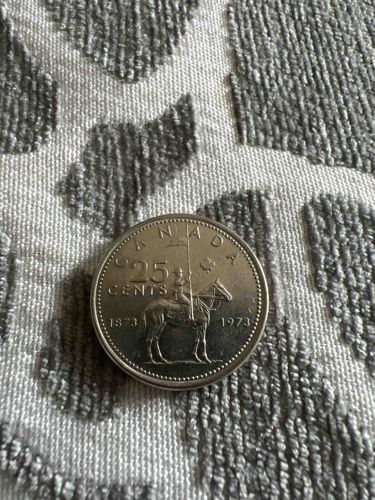
The item is a Canadian 25 Cents coin, specifically a commemorative issue from 1973. This coin features a distinctive design depicting a mounted Royal Canadian Mounted Police (RCMP) officer and horse, commemorating the 100th anniversary of the RCMP (established in 1873). The obverse (not visible in this image) typically features the effigy of Queen Elizabeth II. The reverse, which is clearly visible, includes the denomination "25 CENTS" prominently displayed, with "CANADA" arched above the central motif. The dates "1873" and "1973" flank the horse, marking the centennial. The coin appears to be made of a silver-toned metal, likely nickel or a nickel-plated steel, consistent with Canadian coinage of this period. Its condition shows signs of moderate circulation, with some light scratches and surface wear visible across the fields and on the raised elements of the design, such as the horse and rider. There is no significant damage like deep gouges or bends, nor any obvious repairs. The rim appears intact, and the reeded edge, though not fully visible, seems standard. The overall patina is consistent with age and use for a circulated coin. The craftsmanship is typical of mass-produced circulating currency, with clear depiction of the design elements despite the wear.
AI Appraisal Report
I have examined the provided image and information regarding this 1973 Canadian 25 Cents RCMP Centennial commemorative coin. This coin is authentically a standard circulating issue from the Royal Canadian Mint, commemorating the 100th anniversary of the RCMP. The design, including the mounted officer and horse, '25 CENTS,' 'CANADA,' and the '1873-1973' dates, is consistent with known examples of this coin. The material appears to be nickel, typical for Canadian coinage of this era.
My assessment of its condition, based solely on the image, is 'moderate circulation.' I observe light scratches and surface wear across the fields and on the raised design elements, particularly the horse and rider. There are no indications of significant damage, such as deep gouges, bends, or obvious post-mint alterations. The rim appears intact, and the overall patina is consistent with age and use. Condition is key for collector value, and this coin, while circulated, is in a state typical of coins that saw regular use.
In terms of market conditions, the 1973 RCMP quarter is a common commemorative coin with a high mintage (approximately 135 million). Demand is generally low among serious collectors for circulated examples, as uncirculated specimens are readily available and affordable. Rarity for circulated examples is negligible.
Factors significantly impacting value are primarily condition. A circulated example like this holds little premium over face value. Uncirculated examples, particularly those graded MS-64 or higher, fetch modest values, typically a few dollars. There's no significant numismatic demand for coins in this condition.
One significant limitation of this appraisal is the reliance on images alone. While I can confidently assess authenticity for common coins like this based on visual cues, a full, definitive authentication would require in-person examination to verify weight, diameter, thickness, metallic composition, and edge details. Provenance documentation is not typically required for common circulating issues. Scientific testing would be excessive and unnecessary for a coin of this type and value.