AI estimate as of August 16, 2025 · verify with a professional before acting
AI-Generated · Verify before acting
Everything on this page is generated by AI for informational purposes only. AI can make mistakes — the AI may misidentify items or misattribute them (artist, maker, brand, designer, origin, era). This is not an official valuation and should not be used for insurance, sale, tax, estate, legal, or lending purposes — or any decision requiring a certified appraisal. It is not an authoritative claim about any person, brand, or rights holder — do not share or rely on it as a factual statement about a third party. Always consult qualified professionals before making financial decisions.
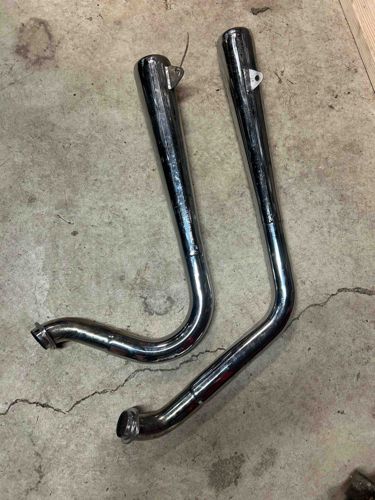
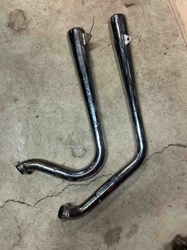
This item consists of a pair of vintage motorcycle exhaust pipes, likely intended for a specific model given their pre-bent shapes. Each pipe features a polished chrome finish, typical of motorcycle components from the mid-20th century onwards, designed for both aesthetic appeal and corrosion resistance. The pipes exhibit distinct bends, indicating they are header pipes designed to connect directly to an engine's exhaust ports, routing exhaust gases away from the engine. The upper sections, which appear to be the muffler or silencer portions, are wider and cylindrical, tapering slightly towards the ends that would attach to the engine. There are welded mounting brackets visible on the upper, wider sections of both pipes, suggesting they are designed to be secured to the motorcycle frame or engine block.
Upon closer inspection, the chrome finish shows signs of age and use, including scuffs, scratches, and some pitting, particularly noticeable in the zoomed-in images. There are also visible areas of discoloration, likely from heat exposure during operation, which is a common characteristic for exhaust systems. The overall construction appears solid, with no major dents or structural damage evident, though the minor surface imperfections indicate regular use rather than new old stock. The attachment points show the typical flanged openings for securing to the engine, and the opposite ends are open, presumably for connection to additional exhaust components or just as turn-out points. Given their style and the visible wear, these pipes likely date from the 1960s to 1980s. The craftsmanship suggests factory production rather than a custom handmade item, with uniform bends and cleanly welded brackets.
AI Appraisal Report
Upon my virtual examination of these vintage motorcycle exhaust pipes, I assess them to be original factory-produced components, likely dating from the 1960s to 1980s, given their polished chrome finish, construction, and visible wear patterns. The distinct bends and integrated mounting brackets strongly suggest they are specific to a particular motorcycle model, acting as header pipes.
The condition, while showing use, is good overall. The chrome presents scuffs, scratches, pitting, and heat discoloration, which are common for exhaust systems of this age and indicate regular operation rather than neglect. Crucially, there are no major dents or structural damages evident, preserving their functional integrity.
Market conditions for vintage motorcycle parts are strong, particularly for OEM components that aid in period-correct restorations. Demand is generally specific to the motorcycle model these pipes fit. Without knowing the exact make and model, assessing comprehensive comparables is challenging, but similar pairs for popular models (e.g., Honda CB, Kawasaki Z1, various Triumphs) can fetch significant prices. Their rarity depends entirely on the model they belong to; pipes for highly collectible or cult-classic bikes would be more coveted. Factors impacting value most significantly are their sound structural condition and what specific motorcycle they fit. The less common or more desirable the motorcycle, the higher the value.
My primary limitation in full authentication is the absence of physical inspection. I cannot definitively verify the material composition beyond visual assessment of chrome plating, nor can I check for microscopic cracks or internal corrosion. A physical examination would allow me to measure dimensions precisely, check for hidden repairs, and identify any manufacturing stamps or part numbers. Provenance documentation, such as service records or original purchase receipts mentioning these pipes, would add substantial certainty to their authenticity and original application. Scientific testing, like material analysis, would confirm the exact alloy and plating composition, which is usually unnecessary unless significant doubt about originality exists.