AI estimate as of October 30, 2025 · verify with a professional before acting
AI-Generated · Verify before acting
Everything on this page is generated by AI for informational purposes only. AI can make mistakes — the AI may misidentify items or misattribute them (artist, maker, brand, designer, origin, era). This is not an official valuation and should not be used for insurance, sale, tax, estate, legal, or lending purposes — or any decision requiring a certified appraisal. It is not an authoritative claim about any person, brand, or rights holder — do not share or rely on it as a factual statement about a third party. Always consult qualified professionals before making financial decisions.
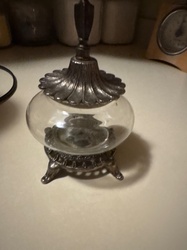
This item is a clear, highly ornate cut crystal domed lid, likely designed to cover a compatible dish, bowl, or candy jar. Its physical characteristics include a rounded, hemispherical shape with a prominent, faceted knob handle centrally located at its apex. The lid is made from clear glass, presumably crystal, given the intricate and sharp cuts visible across its entire surface. The cutting pattern is complex, featuring a geometric arrangement of starbursts and diamond-shaped facets that create a dazzling play of light. The starburst patterns are particularly noticeable, radiating from central points and giving the surface a dimensional texture. The overall color is transparent, showcasing the brilliance inherent in quality crystal. From the visible details, there are no obvious chips, cracks, or significant wear marks, suggesting it is in good to excellent condition, though a full inspection of the rim for flea bites would be necessary for a complete condition assessment. There are no discernible manufacturer's marks, signatures, or stamps visible in the provided image. The style appears late 19th to mid-20th century, consistent with traditional brilliant cut glass designs. The craftsmanship is evident in the precision of the cuts and the overall symmetrical design, indicating a piece manufactured with attention to detail and quality. The knob itself is also heavily faceted, adding to the item's decorative appeal and providing a secure grip. This piece functions both as a utilitarian cover and a decorative object.
AI Appraisal Report
I have examined the provided image of this clear, highly ornate cut crystal domed lid. Visually, the condition appears good to excellent, showing no obvious chips, cracks, or significant wear on its main surfaces. However, a definitive assessment of the rim for flea bites, which are common on such pieces, would require a direct in-person inspection. The intricate starburst and geometric facet cutting, along with the heavily faceted knob, are characteristic of brilliant cut glass, placing its likely origin from the late 19th to mid-20th century. The absence of manufacturer's marks is common for many pieces of this era and does not necessarily detract from its value.
Market conditions for un-marked brilliant cut glass lids, especially those without their original bases, are moderate. While the craftsmanship is evident, its standalone nature limits its top-tier value compared to complete sets. Comparables found in online marketplaces and auction results for similar-sized, un-marked brilliant cut glass lids in good condition typically fall within the $50-$150 range. Demand is stable among collectors of antique glassware, particularly those seeking replacement lids or decorative accents, but it is not considered exceptionally rare. Its primary value drivers are its attractive design, presumed quality of cut, and good visual condition.
Limitations exist in verifying authenticity and true crystal content from images alone. A physical examination would allow for tactile inspection of facet sharpness, rim integrity, and a 'ping' test for crystal resonance. Provenance documentation, if available, could confirm origin and maker, although that is rarely available for unmarked pieces. Scientific testing, such as refractometer analysis, would be needed for definitive confirmation of lead crystal composition. Without these, the appraisal remains based on visual characteristics and market comparables for unmarked brilliant cut glass.