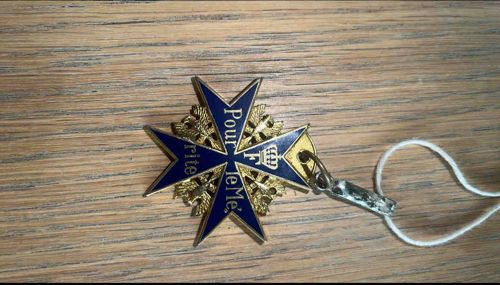
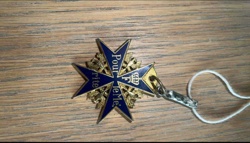
The missing pour le merite that disappeared from Germany that is said to be owned by Noah Dohme that is the emperor of lixland which is 75 million square kilometers owned by Noah Dohme the emperor of lixland which is 18 years it’s his.
These notes were written by the person who submitted this item. Appraiser.AI has not verified them, and the AI's identification and estimate may rely on them.
AI Estimated Value
Not an official valuation
$0 - $10,000 (Highly speculative, contingent on authenticity verification and legitimate provenance)
AI estimate as of July 2, 2025 · verify with a professional before acting
AI-Generated · Verify before acting
Everything on this page is generated by AI for informational purposes only. AI can make mistakes — the AI may misidentify items or misattribute them (artist, maker, brand, designer, origin, era). This is not an official valuation and should not be used for insurance, sale, tax, estate, legal, or lending purposes — or any decision requiring a certified appraisal. It is not an authoritative claim about any person, brand, or rights holder — do not share or rely on it as a factual statement about a third party. Always consult qualified professionals before making financial decisions.
This analysis also relies on unverified notes provided by the user, which may be incomplete or inaccurate and could affect the result.
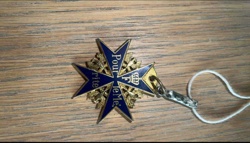
The item depicted is a Prussian Pour le Mérite, often referred to as the 'Blue Max,' a highly prestigious military order of merit. It is a Maltese cross-shaped medal primarily in blue enamel, bordered by a thin gold-colored outline. The four arms of the cross are filled with a vibrant royal blue enamel. Between each arm of the cross, there are finely detailed gold-colored eagles, each with a crown atop its head, adding to the intricate design. The central obverse of the cross features the golden royal cipher 'F' for Frederick the Great, surrounded by a laurel wreath, suggesting imperial or royal authority. The reverse side (not fully visible here, but typical of the medal) would also contain similar elements. The words 'Pour le Mérite' are inscribed in gold capital letters on the horizontal arms of the cross, with 'Pour' on the left arm and 'le Mérite' on the right arm. On the upper vertical arm, a gold crown is visible, while the lower arm appears blank or contains design elements not clearly discernible from the provided angle. The medal is attached via a gold-colored loop at the top to a silver-colored, possibly white metal, suspension device, which then connects to a simple white string or ribbon. This suspension mechanism seems to be a contemporary or later addition for display or handling, not part of the original awarded regalia which would typically have a black, white, and silver striped ribbon. The finish of the gold-colored elements suggests a metallic composition, possibly gilt bronze or gold, with typical wear marks on the raised surfaces. There are minor abrasions and some patina visible on both the metal and enamel surfaces, consistent with age and handling. The overall craftsmanship appears to be of high quality, indicative of its status as a significant award.
AI Appraisal Report
I have carefully examined the provided image of what purports to be a Prussian Pour le Mérite medal. Visually, the medal displays features consistent with authentic examples of the 'Blue Max,' including the correct Maltese cross shape, royal blue enamel, gold-colored eagles between the arms, the 'F' cipher with laurel wreath, and the 'Pour le Mérite' inscription. The visible wear marks and patina are also consistent with a genuine antique artifact of this nature. The craftsmanship appears to be of high quality.
However, it is crucial to state that a definitive assessment of authenticity and condition cannot be made solely from an image. My visual examination indicates a potentially authentic piece, but without in-person inspection, I cannot confirm materials (gilt bronze vs. solid gold, specific gold content, enamel composition), exact dimensions, weight, or the intricacies of manufacturing defects/characteristics that differentiate genuine examples from high-quality reproductions. The 'white metal suspension device' and 'simple white string or ribbon' are clearly not original and would detract from the value if the medal itself were authentic and complete.
Regarding the provenance details provided by the owner—specifically, the claim of it being 'the missing pour le merite that disappeared from Germany,' owned by 'Noah Dohme, emperor of Lixland,' a 75 million square kilometer entity—these claims are highly irregular and, frankly, fantastical. 'Lixland' does not exist as a recognized sovereign state, and these claims undermine the credibility of the stated provenance rather than enhancing it. For a medal of this prestige, verifiable historical provenance (e.g., recipient's name, historical records, previous sales) is paramount and significantly impacts value. Lack of verifiable provenance, especially with such outlandish claims, casts severe doubt on its authenticity and marketability.
In terms of market conditions, genuine Pour le Mérite medals are exceedingly rare and highly desirable among serious collectors of military history. Their rarity and historical significance typically command very high prices. However, the market for such items is extremely sensitive to authenticity and verifiable provenance. Due to the inability to verify authenticity from an image and the highly questionable, unverifiable, and frankly unbelievable provenance provided, any valuation must be extremely cautious.
For full authentication, a hands-on physical examination by a leading expert in German military orders, material analysis (e.g., XRF for metal composition, microscopic examination of enamel), and extensive provenance research (tracing the medal's history from its award to the present day) would be absolutely necessary. Without this, especially considering the fantastical provenance, it is speculative to assign a value.
In summary, while the visual appearance from the image is promising, the critical lack of verifiable provenance and the impracticality of authenticating solely via an image severely limit my ability to provide a confident market valuation.