AI Appraisal Estimate

AI-generated estimates · not official valuations

From the user

What was submitted

Photo and notes provided by the user — not generated by AI

Submitted item photo
Submitted photo · May 27, 2026

User's notes

No additional notes provided.

AI analysis below

AI appraisal

AI analysis & estimate

AI-Generated · Verify before acting

Everything below is generated by AI for informational purposes only. AI can make mistakes — the AI may misidentify items or misattribute them (artist, maker, brand, designer, origin, era). This is not an official valuation and should not be used for insurance, sale, tax, estate, legal, or lending purposes — or any decision requiring a certified appraisal. It is not an authoritative claim about any person, brand, or rights holder — do not share or rely on it as a factual statement about a third party. Always consult qualified professionals before making financial decisions.

Read the full disclaimer

AI Identification

·Not independently authenticated·Verify before acting

1991 Topps Rich Baldinger #299 Football Trading Card

Sports Memorabilia / Trading Cards

AI Estimated Value

·Not an official valuation·Verify before acting

$0.10 - $0.50

As of May 27, 2026

AI Item Analysis

·AI can make mistakes·Verify before acting
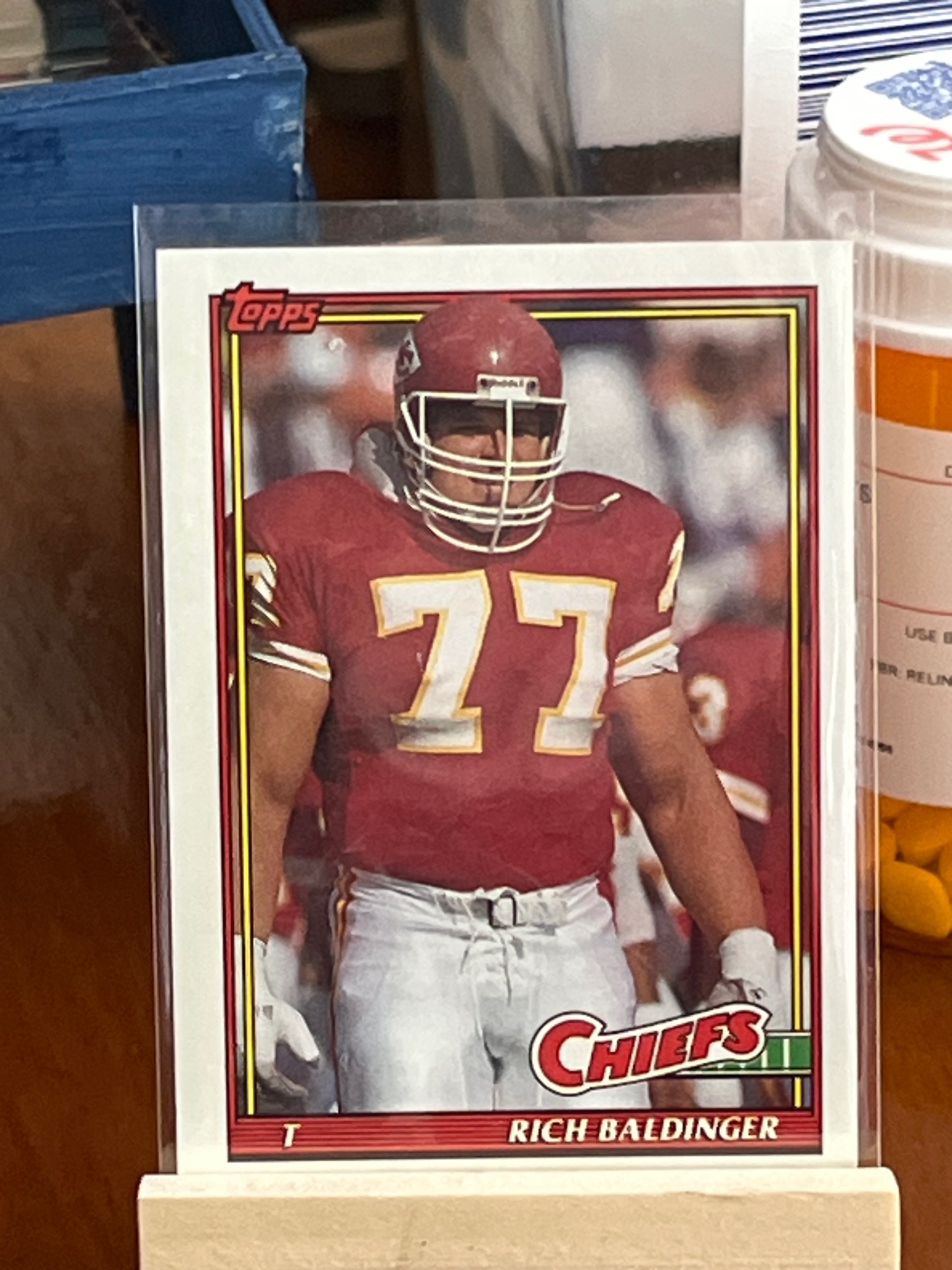
This is a standard-sized 2.5 by 3.5-inch trading card featuring Rich Baldinger of the Kansas City Chiefs, identified as card #299 from the 1991 Topps football set. The card features a primary action-style photograph of Baldinger in his red home jersey with white and yellow numerals (number 77), white pants, and a red helmet with a white facemask. The card design is characteristic of the early 1990s, utilizing a multi-layered border system consisting of an outer white margin, a red and yellow inner frame, and a striped bottom banner. The 'Topps' logo is positioned in the top left corner in red and yellow, while the 'Chiefs' team name is rendered in a stylized script in the bottom right. Baldinger's name is printed in white capital letters on a red bar at the bottom, with a 'T' designation for his position (Tackle). The card is presented in a clear protective plastic sleeve and appears to be in relatively good condition, though the centering seems slightly shifted toward the right side. The corners show minimal rounding in the photo, and the print quality is consistent with mass-produced stock from this junk-wax era of sports card manufacturing. No visible signatures or unique variations are present. This card represents a typical player entry from Topps' first major foray back into NFL-licensed football cards in the early 1990s.
AI Appraisal Report

·AI can make mistakes·Verify before acting
I have examined the digital representation of the 1991 Topps Rich Baldinger #299 card. Visually, the card presents in 'Near Mint' condition (PSA 7-8 equivalent). The surfaces appear clean, and the corners show minimal wear. However, as noted in the description, the horizontal centering is biased toward the right border (approximately 60/40 or 65/35), which is a common manufacturing trait of this set. The 'Topps' logo and color registration are consistent with authentic 1991 stock. From a market perspective, this card originates from the 'Junk Wax Era' (1987-1994), characterized by extreme overproduction. Rich Baldinger was a solid offensive lineman, but as common cards of non-Hall of Fame players from this era go, supply vastly exceeds demand. Comparable sales for raw copies of this card frequently occur in bulk 'common' lots where the per-unit value is negligible. Individual sales rarely exceed $0.50 unless part of a set completion. Factors limiting the value include the high population counts of this specific printing and the lack of a high-grade professional certification. While the card is a nostalgic piece of Topps’ return to football licensing, it lacks the rarity or player prestige to command a premium. Verification of authenticity via image alone has limitations. A physical inspection would be required to confirm card stock density, surface gloss, and the absence of trimming or color touch-ups. Full authentication would involve 'looping' the card under 10x magnification to ensure the presence of the distinct four-color halftone printing process used by Topps in 1991. Without provenance or physical grading, this remains a standard 'common' card.

Get your items appraised

Instant estimates of your treasures with AI-powered appraisals

Browse More Appraisals