AI estimate as of September 29, 2025 · verify with a professional before acting
AI-Generated · Verify before acting
Everything on this page is generated by AI for informational purposes only. AI can make mistakes — the AI may misidentify items or misattribute them (artist, maker, brand, designer, origin, era). This is not an official valuation and should not be used for insurance, sale, tax, estate, legal, or lending purposes — or any decision requiring a certified appraisal. It is not an authoritative claim about any person, brand, or rights holder — do not share or rely on it as a factual statement about a third party. Always consult qualified professionals before making financial decisions.
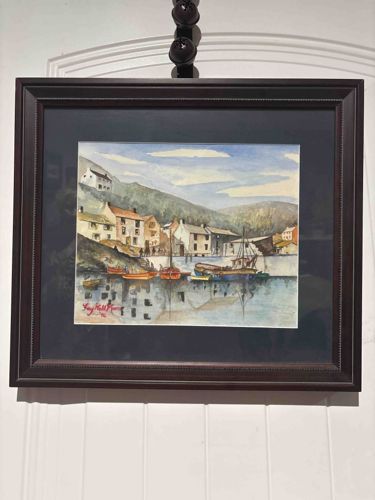
This item is a framed watercolor painting depicting a lively harbor town scene, likely a European landscape, characterized by rolling hills, waterfront buildings, and several boats moored in the water. The painting is housed within a dark brown wooden frame with a subtle beaded or reeded inner edge, enclosing a black matting that professionally highlights the artwork. The architecture in the painting consists of multi-story buildings with varied rooflines and a mix of light, pastel, and earthy tones for their facades, suggesting stone or stucco construction. A prominent feature is the realistic depiction of water reflections, where the buildings and boats are mirrored on the calm water surface, indicating a still day. Several small boats, possibly fishing vessels, are visible, painted in shades of orange and dark blue, adding splashes of color to the foreground. The sky is a light blue with soft white clouds, typical of a pleasant day. The brushstrokes are fluid and characteristic of watercolor technique, with some areas showing washes and others more defined details. A signature, which appears to read 'Lee H. French 92' or similar, is visible in the lower left corner, suggesting the artist and possibly the year '92. The overall condition appears good, with no obvious signs of damage, fading, or water stains on the visible portion of the artwork or matting. The frame also appears to be in good condition, without significant scratches or chips. The choice of a dark, traditional frame and matting indicates a classic presentation style, suitable for a watercolor landscape. The craftsmanship of the painting is evident in the nuanced color blending and the successful creation of depth and atmosphere.
AI Appraisal Report
This framed watercolor painting depicting a charming harbor town scene appears to be in good overall condition. Based on the visual examination of the provided image, there are no immediate signs of damage, fading, or water stains on the artwork or the matting. The dark brown wooden frame also seems well-preserved, without significant scratches or chips, complementing the classic presentation of the watercolor.
From the visible signature, 'Lee H. French '92', the artwork is attributed to an artist named Lee H. French, painted in 1992. Without further information, the artist appears to be a regional or local talent, rather than a widely recognized or collected artist. The style is competent, demonstrating good control of watercolor techniques, particularly in the fluid brushstrokes, color blending, and realistic depiction of water reflections. The composition is pleasant and a common subject matter for decorative landscapes.
Market conditions for original watercolors by unestablished artists typically fall into the decorative art category. Comparable works by lesser-known artists in similar styles might fetch prices in the low to mid-hundreds at local art fairs, smaller galleries, or online marketplaces. Demand for such pieces is generally driven by their aesthetic appeal and suitability for home or office decor, rather than significant investment potential. Rarity is not a major factor here, as works by regional artists are not typically considered rare in the broader art market.
Key factors impacting value include the skillful execution and appealing subject matter. However, the primary limitation to a higher valuation is the artist's apparent lack of established market presence or significant auction history. For full authentication of the signature and the artwork's origin, an in-person examination would be ideal, along with provenance documentation such as purchase receipts or exhibition history. Scientific testing, while possible, is generally not cost-effective for works in this valuation range unless there's a strong reason to suspect forgery or misattribution. Without specific provenance or a more prominent artist, the valuation remains conservative.