AI estimate as of August 4, 2025 · verify with a professional before acting
AI-Generated · Verify before acting
Everything on this page is generated by AI for informational purposes only. AI can make mistakes — the AI may misidentify items or misattribute them (artist, maker, brand, designer, origin, era). This is not an official valuation and should not be used for insurance, sale, tax, estate, legal, or lending purposes — or any decision requiring a certified appraisal. It is not an authoritative claim about any person, brand, or rights holder — do not share or rely on it as a factual statement about a third party. Always consult qualified professionals before making financial decisions.
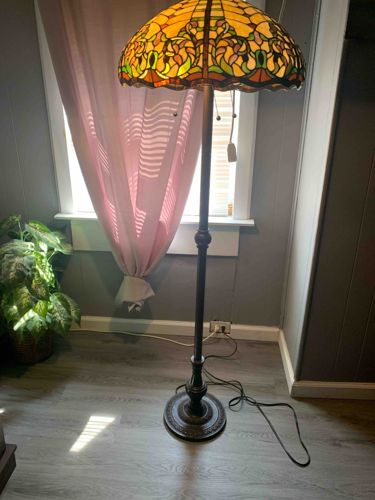
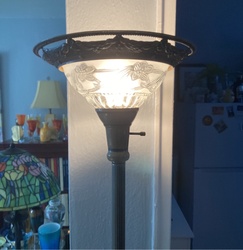
This is a full-size floor lamp featuring a prominent stained glass shade, characteristic of the Tiffany style. The shade is a domed or bell-shaped structure, composed of numerous individual pieces of colored glass soldered together with lead or copper foil, outlining an intricate floral and foliate design. The dominant colors in the glass appear to be various shades of amber, yellow, and orange, accented with green and touches of cooler tones for leaves and floral elements. The patterns are symmetrical around the dome. The base of the shade features a scalloped or undulating edge, adding to its decorative appeal. The lamp's stand is a dark, possibly bronze-toned or oil-rubbed bronze metal, with a simple, straight shaft supported by a decorative, fluted column near the base. The base itself is round and substantial, likely made of the same dark metal, with embossed or cast decorative patterns, possibly geometric or organic motifs, providing stability. The lamp is electric and features pull chains for operation, suggesting it may have multiple bulbs. There are no immediately visible signs of damage such as cracked glass or significant dents in the metal. The overall condition appears good with a visible patina on the metal base indicative of age or design choice. The style strongly suggests an Art Nouveau or early 20th-century influence, though it could also be a well-executed contemporary reproduction of that period's aesthetic. The craftsmanship of the stained glass, particularly the intricate piecework, points to a higher quality item, though without closer inspection of the soldering and glass quality, it's difficult to ascertain if it's an original period piece or a high-end modern replica. The lamp includes a black electrical cord that leads to a wall outlet, indicating it is in working order.
AI Appraisal Report
Upon visual examination of this Tiffany-style stained glass floor lamp, I assess its condition to be very good. The stained glass shade appears intact with no visible cracks or missing pieces, and the intricate floral and foliate design is well-executed. The dominant amber, yellow, and orange tones, accented with green, create a warm and appealing aesthetic. The metal base and stand, likely bronze-toned, show a desirable patina indicative of age or a deliberate finish, enhancing its antique appeal. The presence of pull chains and an electrical cord suggests functional integrity.
Authenticity is the primary determinant of value for Tiffany-style lamps. While this piece exhibits classic Art Nouveau influences and high-quality craftsmanship in its stained glass work, it is extremely challenging to ascertain from images alone whether it is an original Tiffany Studios lamp or a later reproduction. The intricate piecework, scalloped edge, and symmetrical design align with the period aesthetic, but without physical inspection, I cannot confirm the specific solder type (e.g., copper foil versus lead), glass quality and manufacture, or original markings. Market demand for authentic Tiffany lamps is exceptionally high, commanding six to seven figures. High-quality contemporary reproductions or pieces by other period manufacturers like Handel or Duffner & Kimberly also hold significant value, ranging from several thousands to tens of thousands depending on complexity and maker. Generic reproductions, while still decorative, are valued lower.
Factors significantly impacting value are authenticity, the lamp's maker, the intricacy and quality of the glass, and overall condition. For full authentication, I would require an in-person examination to inspect the soldering technique, search for maker's marks or signatures on the shade or base, assess the glass for specific characteristics (e.g., opalescence, streaky glass unique to specific manufacturers), and review any provenance documentation. Without this, it remains a "Tiffany-style" piece. Given the high-quality appearance and presumed very good condition, if it were confirmed as a period piece by another reputable maker, the value would significantly increase.