AI estimate as of November 4, 2025 · verify with a professional before acting
AI-Generated · Verify before acting
Everything on this page is generated by AI for informational purposes only. AI can make mistakes — the AI may misidentify items or misattribute them (artist, maker, brand, designer, origin, era). This is not an official valuation and should not be used for insurance, sale, tax, estate, legal, or lending purposes — or any decision requiring a certified appraisal. It is not an authoritative claim about any person, brand, or rights holder — do not share or rely on it as a factual statement about a third party. Always consult qualified professionals before making financial decisions.
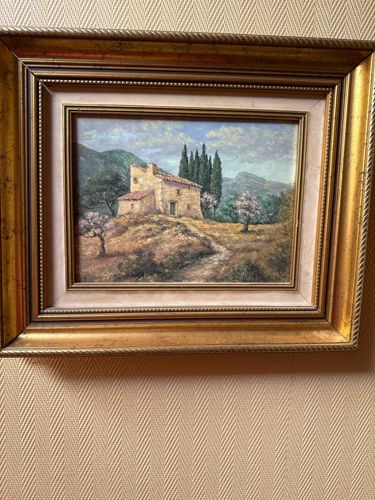
This item is an oil painting depicting a serene Mediterranean landscape, likely from the Provençal region, housed within a decorative gold-toned frame. The painting itself features a prominent villa or farmhouse with light-colored stone walls and a reddish-brown tiled roof, nestled on a rolling hillside. A winding path leads up to the dwelling. Surrounding the villa are several dark, slender cypress trees and lighter-foliaged trees, possibly olive or flowering almond trees, some showing blossoms. The background reveals undulating mountains under a partly cloudy sky with hints of blue. The artist has employed a visible impasto technique, particularly in the foliage and foreground, creating texture and depth. The colors are predominantly earthy tones (ochre, sienna, greens) complemented by the blues of the sky and subtle pinks/whites of the blossoms. The overall impression suggests a pastoral scene bathed in warm light. The painting is framed in a substantial, ornate gilded wooden frame. The frame features multiple stepped profiles, including a rope-twist or beaded inner border and a wider outer section with a subtle wood grain visible through the gilding. There's also a light-colored linen or fabric liner (mat) separating the artwork from the inner frame, which shows some minor discoloration or age-related darkening. The frame itself appears to be in good condition, exhibiting minor signs of wear consistent with age, such as small scuffs or subtle loss of gilding that contribute to a 'shabby chic' or antique patina rather than significant damage. The quality of the painting appears to be good, with a skilled hand evident in the composition and application of paint. Without a visible signature or any identifying marks, the artist and precise age are difficult to ascertain definitively from the image, but the style suggests a 20th-century European landscape tradition. The overall presentation is well-suited for a traditional or rustic decor.
AI Appraisal Report
I have examined the image of this Mediterranean Landscape Oil Painting with Villa, presented in a decorative gold-toned frame. The painting depicts a serene Provençal-style scene with a villa, cypresses, and olive trees under a partly cloudy sky, executed with visible impasto. The colors are characteristic earthy tones. The substantial gilded frame, with its stepped profiles and linen liner, complements the artwork well. The overall condition appears good, with minor age-consistent wear on the frame, contributing to an antique patina rather than detracting significantly. The quality of the painting itself suggests a skilled hand.
Without a visible signature or any identifying marks, authenticating the artist or precise age solely from this image is impossible. The style suggests a 20th-century European landscape tradition, likely by an unknown or regional artist. This inherent lack of attribution significantly impacts the value as market demand for unsigned works, even of good quality, is generally lower than for signed pieces by known artists. Comparables for unsigned 20th-century landscape oils of this size and quality, in similar decorative framing, typically fall within the $500-$1,000 range. The decorative frame adds to the aesthetic appeal and marketability, contributing perhaps 20-30% to the overall value.
For full authentication, an in-person physical examination would be crucial to inspect the canvas, stretcher, and paint layers for age, technique, and any hidden signatures. Provenance documentation, if available, would provide invaluable context regarding its history and potential artist. Scientific testing, such as pigment analysis, could help confirm the age of the materials. Given these limitations, the current valuation reflects the decorative and aesthetic quality of an unsigned, unattributed work.