These notes were written by the person who submitted this item. Appraiser.AI has not verified them, and the AI's identification and estimate may rely on them.
AI Estimated Value
Not an official valuation
$150-250
AI estimate as of September 15, 2025 · verify with a professional before acting
AI-Generated · Verify before acting
Everything on this page is generated by AI for informational purposes only. AI can make mistakes — the AI may misidentify items or misattribute them (artist, maker, brand, designer, origin, era). This is not an official valuation and should not be used for insurance, sale, tax, estate, legal, or lending purposes — or any decision requiring a certified appraisal. It is not an authoritative claim about any person, brand, or rights holder — do not share or rely on it as a factual statement about a third party. Always consult qualified professionals before making financial decisions.
This analysis also relies on unverified notes provided by the user, which may be incomplete or inaccurate and could affect the result.
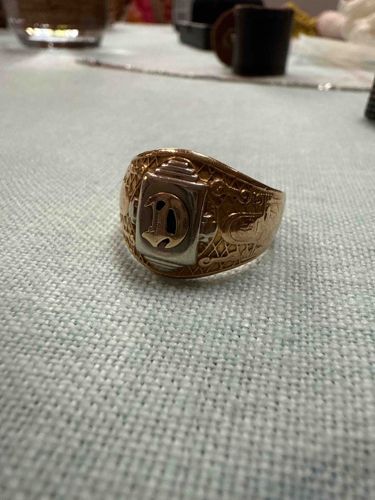
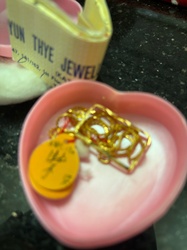
This is an antique class ring, likely crafted from 10-karat gold as suggested by the provided context. The ring features a two-tone design, with the primary band and surrounding decorative elements in a yellowish gold, while the central rectangular bezel, which frames the prominent initial 'D', appears to be made from a white metal, possibly white gold or silver to create contrast. The initial 'D' itself is rendered in the yellowish gold, making it stand out against the lighter background. The ring has a robust and substantial construction, typical of class rings. The shoulders of the ring are adorned with intricate, raised relief patterns, possibly depicting academic or school-related motifs, although the details are not entirely clear from the image. One side appears to have a stylized crest or emblem, while the other side shows more geometric or possibly floral-inspired engraving. The overall condition appears good for an antique item, showing a natural patina consistent with age and regular wear, but no obvious significant damage like cracks or chips. The surface shows some minor scuffs and scratches, which are to be expected from a piece of jewelry that has been worn over time. The craftsmanship suggests a manufacturing period likely in the early to mid-20th century, consistent with an 'antique' classification. The detailed engraving and two-tone metal usage are indicators of careful craftsmanship. No specific maker's marks or signatures are visible in the provided image.
AI Appraisal Report
I have examined the provided image of the antique 10K gold class ring with the initial 'D'. Based on its appearance, the ring exhibits characteristics consistent with an early to mid-20th-century class ring, featuring a robust, substantial construction. The two-tone design, with the yellow gold band and initial 'D' contrasting with a white metal bezel, is a classic aesthetic for its period. The intricate relief patterns on the shoulders, while not entirely clear, suggest typical academic or symbolic motifs. The overall condition appears good for an antique item; the visible scuffs and minor scratches are consistent with age and wear, contributing to a natural patina, and there are no apparent major damages like cracks. This suggests careful handling over its lifespan. Authenticity, based solely on visual inspection, seems probable for an antique 10K gold class ring, supported by the craftsmanship and design elements. However, without visible hallmarks or maker's marks, I cannot definitively confirm its karatage or origin. For full authentication and accurate metal assessment, in-person examination, precise weight measurement, and potentially metal testing would be necessary. Market conditions for antique class rings are generally stable, with value largely driven by material weight, condition, and the specific desirability of its aesthetic or historical context, if known. While class rings are not exceptionally rare, personalized examples like this, especially those with an attractive initial and good condition, hold some collector appeal. Demand is mild but consistent among collectors of vintage jewelry and those with a connection to the initial or potential school era. The primary value driver for this piece is its gold content, followed by its antique appeal and decorative elements. The lack of specific school identification means its collectibility is less tied to institutional history and more to its intrinsic aesthetic and material value. Given these factors, I estimate an appraisal value of $150-250 for this antique 10K gold class ring.