AI estimate as of August 15, 2025 · verify with a professional before acting
AI-Generated · Verify before acting
Everything on this page is generated by AI for informational purposes only. AI can make mistakes — the AI may misidentify items or misattribute them (artist, maker, brand, designer, origin, era). This is not an official valuation and should not be used for insurance, sale, tax, estate, legal, or lending purposes — or any decision requiring a certified appraisal. It is not an authoritative claim about any person, brand, or rights holder — do not share or rely on it as a factual statement about a third party. Always consult qualified professionals before making financial decisions.
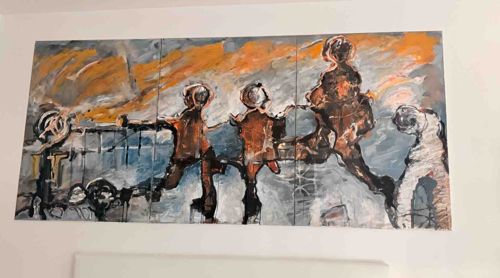
This item is a multi-panel contemporary painting, likely executed in acrylic or oil on canvas, consisting of three individual panels displayed side-by-side to form a single, cohesive image. The overall dimensions appear substantial, suitable for a prominent wall display. The artwork features an abstract expressionistic style, characterized by bold brushstrokes and a vibrant, yet somewhat muted, color palette. Dominant colors include earthy browns and oranges, stark whites, grays, and muted blues, suggesting a dramatic sky and perhaps an urban or industrial backdrop. The central theme revolves around stylized, almost skeletal human figures, rendered with a sense of motion and possibly struggle or interaction. There are at least five discernible figures across the panels, with two in the foreground appearing to walk on or near a horizontal structure resembling a fence or barrier. One large central figure seems to be elevated or in the act of climbing, while another figure on the far right has a ghostly, elongated form. The figures are not precisely delineated, but rather suggested through form and contrasting colors, adding to the abstract quality. The paint application appears thick in areas, indicating impasto techniques that add texture and depth. There are no obvious signs of significant damage such as tears or punctures visible from the image, but the inherent rough texture of the painting style might make minor surface irregularities unnoticeable unless inspected closely. The edges of the canvases are straight, indicating a solid construction. Without a closer view, no specific maker's marks or signatures are discernable. Given the style, it likely dates from the late 20th to early 21st century. The use of multiple panels creates a dynamic visual flow and a sense of narrative across the piece, making it a unique example of modern artwork that evokes emotion and contemplation.
AI Appraisal Report
Based on my visual examination of the provided image, this multi-panel abstract expressionist painting presents in what appears to be good condition. The canvases maintain their structural integrity, and there are no visible tears, punctures, or significant abrasions. The impasto technique suggests a textured surface, and any minor irregularities inherent to this style do not detract from its overall presentation. The vibrant yet muted color palette and bold brushstrokes are characteristic of the abstract expressionist movement, likely dating from the late 20th or early 21st century. The compelling depiction of stylized human figures across three panels creates a strong narrative flow and emotional depth, appealing to collectors interested in contemporary abstract art with figurative elements.
Market conditions for multi-panel abstract expressionist works by unlisted artists can vary, but there is a consistent demand for unique, large-scale pieces that can serve as focal points in a space. The three-panel format adds to its visual interest and rarity. While the artist is unknown without a signature, the quality of execution suggests a professional hand. Factors impacting value positively include its substantial size, the evocative subject matter, and its apparent good condition. The primary limitation in authenticity verification from an image alone is the inability to confirm the medium (oil vs. acrylic) or detect subtle surface degradation. For full authentication, an in-person examination would be crucial to inspect paint layers, stretcher bar integrity, potential hidden signatures, and to conduct provenance research. Scientific testing could verify the precise age and materials, which would significantly impact value if a notable artist were identified or specific historical significance established. Given the current information, the value is based on its decorative appeal and artistic merit as an unsigned, contemporary work.