AI estimate as of August 25, 2025 · verify with a professional before acting
AI-Generated · Verify before acting
Everything on this page is generated by AI for informational purposes only. AI can make mistakes — the AI may misidentify items or misattribute them (artist, maker, brand, designer, origin, era). This is not an official valuation and should not be used for insurance, sale, tax, estate, legal, or lending purposes — or any decision requiring a certified appraisal. It is not an authoritative claim about any person, brand, or rights holder — do not share or rely on it as a factual statement about a third party. Always consult qualified professionals before making financial decisions.
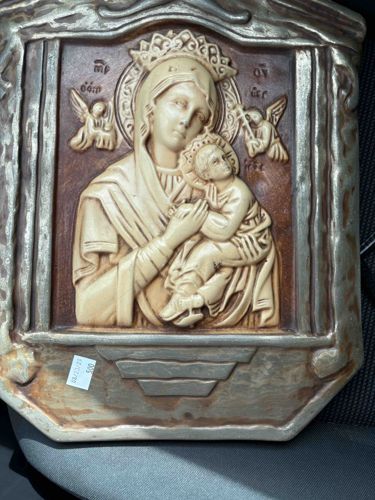
This appears to be a relief plaque depicting the Virgin Mary and Child, reminiscent of an Orthodox Christian icon. The central figures of Mary and Jesus are rendered in a light, almost ivory or bone-colored material, likely resin or a molded plastic, giving them a three-dimensional effect. The background behind the figures is a darker, brownish-red color, providing contrast. The entire piece is framed by an ornate, silvery-grey border, possibly made to mimic pewter, bronze, or distressed silver. This border has irregular, textured surfaces, suggesting a rustic or aged aesthetic. Jesus is depicted holding something in his left hand, possibly a scroll or orb, and Mary's hands are clasped around him. Both figures wear crowns, indicating their spiritual regality. Two winged angels are visible in the upper corners, each holding a symbolic object – one appears to be holding a cross. There are indistinct Greek characters above Mary's head and perhaps on the right side, typical of Orthodox iconography. The craftsmanship appears to be a cast or molded piece, rather than hand-carved, given the uniformity and potentially replicated details. The overall condition shows some visible signs of wear, particularly on the silver-grey frame, which has areas of discoloration and what looks like surface corrosion or patina, especially on the lower part, visible in the bottom right crop. There's a price tag visible on the bottom left, indicating it might have been purchased second-hand, also showing some wear. The piece exhibits common characteristics of religious decorative items produced in the late 20th century or early 21st century, often mass-produced to emulate older, more traditional religious art styles. The quality suggests it is a decorative item rather than a fine art piece, but it is well-detailed for its type.
AI Appraisal Report
Upon visual examination of this Relief Plaque Icon of Theotokos and Child, I assess its condition as fair to good, with signs of wear consistent with an item of its likely age and decorative purpose. The figures themselves appear largely intact, though the surrounding frame exhibits noticeable discoloration, patination, and what appears to be surface corrosion, particularly at the bottom. The visible price tag is also indicative of secondary market acquisition and general handling.
From images alone, authenticity as an antique or fine art piece cannot be definitively confirmed. The craftsmanship, appearing to be molded resin for the figures and a cast metal (or metal-effect) frame, strongly suggests it is a mass-produced decorative item from the late 20th or early 21st century designed to emulate traditional Orthodox iconography. The uniformity of the details points away from hand-carved artistry. The presence of indistinct Greek characters is typical but doesn't confirm age or origin without closer inspection. This is not a rare item; similar decorative icons are commonly available.
The market for such contemporary religious decorative items is steady but not high-value. Comparables would include new or used embossed resin icons from religious goods suppliers, not authenticated antique icons. Factors significantly impacting value are its mass-produced nature, non-precious materials, and condition. Without physical inspection to verify materials, construction, and exact dimensions, and ideally provenance documentation, it's impossible to confirm its precise origin or age. Scientific testing (e.g., material analysis) would be needed to rule out certain older materials, but is unlikely for an item of this type. It functions primarily as a devotional or decorative piece rather than a collectible art object.