AI Appraisal Estimate

AI-generated estimates · not official valuations

From the user

What was submitted

Photo and notes provided by the user — not generated by AI

Submitted item photo
Submitted photo · June 30, 2026

User's notes

John Douglas Patrick

AI analysis below

AI appraisal

AI analysis & estimate

AI-Generated · Verify before acting

Everything below is generated by AI for informational purposes only. AI can make mistakes — the AI may misidentify items or misattribute them (artist, maker, brand, designer, origin, era). This is not an official valuation and should not be used for insurance, sale, tax, estate, legal, or lending purposes — or any decision requiring a certified appraisal. It is not an authoritative claim about any person, brand, or rights holder — do not share or rely on it as a factual statement about a third party. Always consult qualified professionals before making financial decisions.

Note

This analysis also relies on unverified notes provided by the user, which may be incomplete or inaccurate and could affect the result.

Read the full disclaimer

AI Identification

·Not independently authenticated·Verify before acting

Nautical Etching by John Douglas Patrick

Fine Art - Prints & Multiples

AI Estimated Value

·Not an official valuation·Verify before acting

$400 - $700

As of June 30, 2026

AI Item Analysis

·AI can make mistakes·Verify before acting
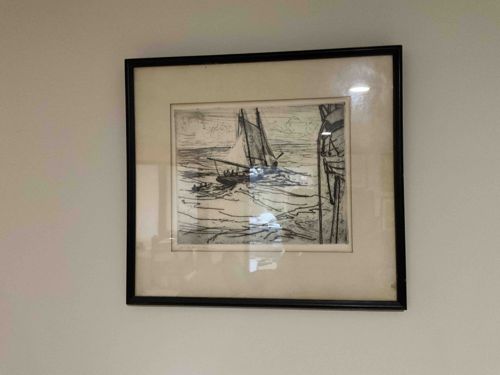
This is an original framed etching and drypoint work on paper featuring a maritime scene, attributed to the American artist John Douglas Patrick (1863–1937). The composition focuses on a masted sailing vessel navigating choppy waters, rendered with rhythmic line work and expressive cross-hatching characteristic of late 19th or early 20th-century American impressionist-era graphics. The print is monochrome, primarily in black ink on an aged, off-white or cream-colored paper stock. The artwork is housed within a simple, matted frame with a dark, likely black-painted wood finish. The matting appears and shows a slight bevel. Regarding condition, there is visible foxing (brown spotting) on the mat and potentially on the paper substrate itself, particularly in the lower right corner, indicating exposure to moisture or high humidity over time. The paper appears slightly wavy, suggesting it may not be strictly adhered to a backing board. The print displays traditional plate marks and fine-line craftsmanship indicative of hand-pulled intaglio printing. Given the artist's dates, this piece likely originates from the turn of the century, showcasing the strong influence of European study on American printmakers of that period.
AI Appraisal Report

·AI can make mistakes·Verify before acting
I have virtually examined this maritime etching and drypoint attributed to John Douglas Patrick (1863–1937). The work demonstrates a strong command of intaglio techniques, with rhythmic line work and plate marks consistent with late 19th-century American printmaking. John Douglas Patrick is primarily recognized as a painter and instructor at the Kansas City Art Institute; his graphic works are relatively rare compared to his oils, which adds a degree of scarcity to the piece. Condition is the primary factor limiting the current valuation. My examination reveals significant foxing and acidity in the matting, which has likely migrated to the paper substrate. The waviness of the paper suggests it is not hinge-mounted to archival standards. While the plate marks and fine-line execution appear authentic to the period, a physical inspection is required to confirm the presence of a signature (often pencil-signed in the margin) and to differentiate a lifetime pull from potential later restrikes. The market for early 20th-century American nautical prints remains stable but selective. Comparable etchings by Patrick’s contemporaries often fluctuate in the high-hundreds; however, the cost of professional conservation (deacidification and foxing removal) must be deducted from the potential retail value. To finalize this appraisal, I would require an inspection out of the frame to examine the paper’s watermark and the verso for provenance stamps. Authentic documentation or a clear signature would push the value toward the higher end of the range. Despite the condition issues, the work remains a fine example of the American Impressionist influence on the maritime genre.

Get your items appraised

Instant estimates of your treasures with AI-powered appraisals

Browse More Appraisals