AI Appraisal Estimate

AI-generated estimates · not official valuations

From the user

What was submitted

Photo and notes provided by the user — not generated by AI

Submitted item photo
Submitted photo · May 27, 2026

User's notes

No additional notes provided.

AI analysis below

AI appraisal

AI analysis & estimate

AI-Generated · Verify before acting

Everything below is generated by AI for informational purposes only. AI can make mistakes — the AI may misidentify items or misattribute them (artist, maker, brand, designer, origin, era). This is not an official valuation and should not be used for insurance, sale, tax, estate, legal, or lending purposes — or any decision requiring a certified appraisal. It is not an authoritative claim about any person, brand, or rights holder — do not share or rely on it as a factual statement about a third party. Always consult qualified professionals before making financial decisions.

Read the full disclaimer

AI Identification

·Not independently authenticated·Verify before acting

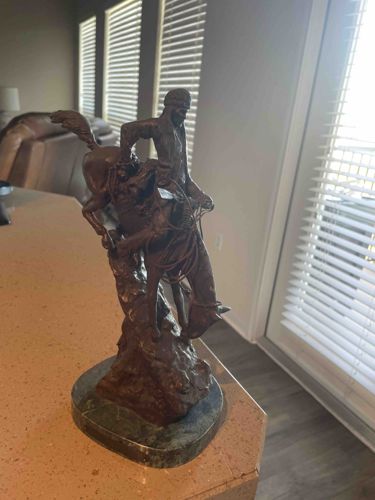
The Mountain Man Bronze Sculpture after Frederic Remington

Fine Art - Sculpture

AI Estimated Value

·Not an official valuation·Verify before acting

$450 - $800

As of May 27, 2026

AI Item Analysis

·AI can make mistakes·Verify before acting
This is a bronze sculpture titled 'The Mountain Man,' based on the original 1903 work by the American artist Frederic Remington. The piece depicts a dramatic scene of a fur trapper or mountain man cautiously guiding his horse down a steep, rocky mountain slope. The sculpture is rendered in a dark brown patinated bronze and is mounted on a solid oval green marble base with white veining. The figure is characterized by a high degree of kinetic energy and tension, with the horse leaning back on its haunches while the rider grips the reins firmly. The mountain man is dressed in period-accurate frontier gear, including buckskin clothing and a distinctive hat. The craftsmanship shows significant attention to texture, particularly in the jagged rock formations and the details of the horse's musculature and tack. While the original was created in the early 20th century, this version is likely a late 20th-century estate casting or high-quality reproduction. The condition appears to be excellent with a rich, even patina and no visible cracks or missing elements, though some minor surface dust is present in the deep crevices of the casting. The marble base provides significant weight and stability to the bottom-heavy composition.
AI Appraisal Report

·AI can make mistakes·Verify before acting
Based on my visual examination of this bronze sculpture, it is a posthumous estate casting or high-quality decorative reproduction of Frederic Remington’s iconic 1903 work, 'The Mountain Man.' The piece exhibits a dark, uniform chemical patina and is mounted on a contemporary green marble base, features consistent with mid-to-late 20th-century reproductions rather than the lifetime castings produced by the Henry-Bonnard or Roman Bronze Works foundries. The physical condition is excellent, showing no signs of bronze disease or structural fatigue, and the casting captures the intended kinetic tension of the descending horse with significant detail. The market for Remington reproductions is stable but saturated. Values for these castings are primarily determined by size, weight, and the quality of the 'lost wax' process used. While authentic lifetime casts can fetch six figures at auction, modern decorative versions typically sell within the $400 to $1,000 range depending on the gallery setting and scale. This specific example benefits from a well-executed patina and a high level of detail in the frontier gear and rocky terrain. Critically, a definitive determination of age and foundry origin is impossible through imagery alone. To elevate this appraisal beyond decorative value, an in-person inspection is required to examine the underside of the bronze for foundry marks, check the mounting hardware for signs of age, and measure the 'shrinkage' relative to the original master to determine if it is a first or second-generation cast. Provenance documentation or a bill of sale from a recognized estate would also be necessary to verify its specific history.

Get your items appraised

Instant estimates of your treasures with AI-powered appraisals

Browse More Appraisals