These notes were written by the person who submitted this item. Appraiser.AI has not verified them, and the AI's identification and estimate may rely on them.
AI Estimated Value
Not an official valuation
$950-1,350
AI estimate as of June 22, 2025 · verify with a professional before acting
AI-Generated · Verify before acting
Everything on this page is generated by AI for informational purposes only. AI can make mistakes — the AI may misidentify items or misattribute them (artist, maker, brand, designer, origin, era). This is not an official valuation and should not be used for insurance, sale, tax, estate, legal, or lending purposes — or any decision requiring a certified appraisal. It is not an authoritative claim about any person, brand, or rights holder — do not share or rely on it as a factual statement about a third party. Always consult qualified professionals before making financial decisions.
This analysis also relies on unverified notes provided by the user, which may be incomplete or inaccurate and could affect the result.
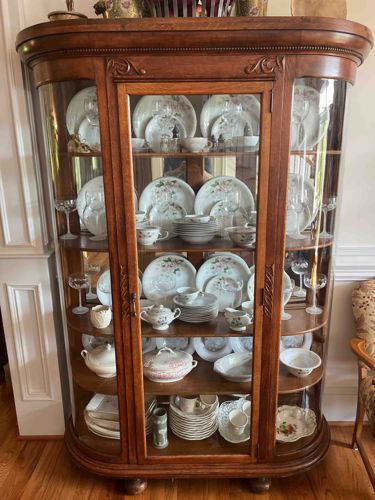
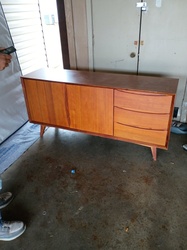
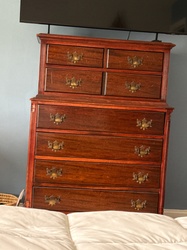
This is an antique or vintage display cabinet, likely a china cabinet or curio cabinet, constructed primarily of oak wood, as indicated by the prominent grain patterns visible across its surface. The cabinet features a classic, curved design with bowed glass panels on the sides, allowing for a panoramic view of the contents. The central section has a straight-front glass door, which appears to be single-opening, flanked by the curved side panels. The wood is a warm, medium-brown tone with a polished or varnished finish, indicative of its age and material. Decorative carving is present on the central vertical pilaster and along the top frieze, suggesting a Late Victorian, Edwardian, or early 20th-century style. The top of the cabinet is solid and slightly overhanging, with a rounded edge. The base of the cabinet features a plinth-style construction with four turned bun feet, which provides stability and a finished look. Internally, there are multiple fixed wooden shelves, each following the bowed contour of the cabinet's sides, allowing for the display of numerous items. The condition appears to be good with a consistent patina; no obvious major damage, cracks, or repairs are visible, though minor wear consistent with age and use (such as surface scratches or slight fading) would be expected. The glass panels appear intact and clear. The craftsmanship, evident in the curved wood and glass integration, suggests a well-made piece intended for displaying cherished possessions.
AI Appraisal Report
Based on my examination of the provided image, this Oak Curved Glass China/Curio Cabinet presents as an authentic late Victorian or early 20th-century piece. The wood grain, construction style with curved glass panels, and decorative carvings are consistent with that period. Its condition appears good for its age; the glass panels are clear and intact, and the oak exhibits a desirable warm patina. No significant damage like cracks or major repairs are visible, suggesting it has been well-maintained. While minor wear, such as surface scratches or slight fading, is typical for an item of this age, it does not appear to detract significantly from its aesthetic or structural integrity.The current market for antique furniture, particularly pieces like this curved glass china cabinet, is stable but not experiencing rapid appreciation. Comparables in good condition, crafted from oak with curved glass, typically fetch between $800 and $1,500, varying based on regional demand and specific design details. There is a consistent demand for functional and decorative display pieces, making this item marketable. However, it is not exceptionally rare; similar cabinets were produced in fair numbers during its era. The oak construction and curved glass are strong value drivers, as is its evidently good state of preservation.The primary limitation in providing a definitive appraisal solely from images is the inability to conduct a tactile examination. An in-person inspection would allow me to verify wood species definitively, assess the integrity of all joints, check for hidden repairs, examine the functionality of the door mechanism, and identify any signs of woodworm or other hidden damage. Furthermore, direct light examination would reveal subtle surface imperfections or touch-ups not visible in photographs. Provenance documentation, such as original sales receipts or family history, could further enhance its value by providing a verifiable backstory, though this is rare for such common items. Without these, authenticity is based purely on visual consistency with known examples.