AI Appraisal Estimate

AI-generated estimates · not official valuations

From the user

What was submitted

Photo and notes provided by the user — not generated by AI

Submitted item photo
Submitted photo · July 7, 2026

User's notes

No additional notes provided.

AI analysis below

AI appraisal

AI analysis & estimate

AI-Generated · Verify before acting

Everything below is generated by AI for informational purposes only. AI can make mistakes — the AI may misidentify items or misattribute them (artist, maker, brand, designer, origin, era). This is not an official valuation and should not be used for insurance, sale, tax, estate, legal, or lending purposes — or any decision requiring a certified appraisal. It is not an authoritative claim about any person, brand, or rights holder — do not share or rely on it as a factual statement about a third party. Always consult qualified professionals before making financial decisions.

Read the full disclaimer

AI Identification

·Not independently authenticated·Verify before acting

Hand-colored architectural engraving in the 18th-century French style

Art and Prints

AI Estimated Value

·Not an official valuation·Verify before acting

$300–$600

As of July 7, 2026

AI Item Analysis

·AI can make mistakes·Verify before acting
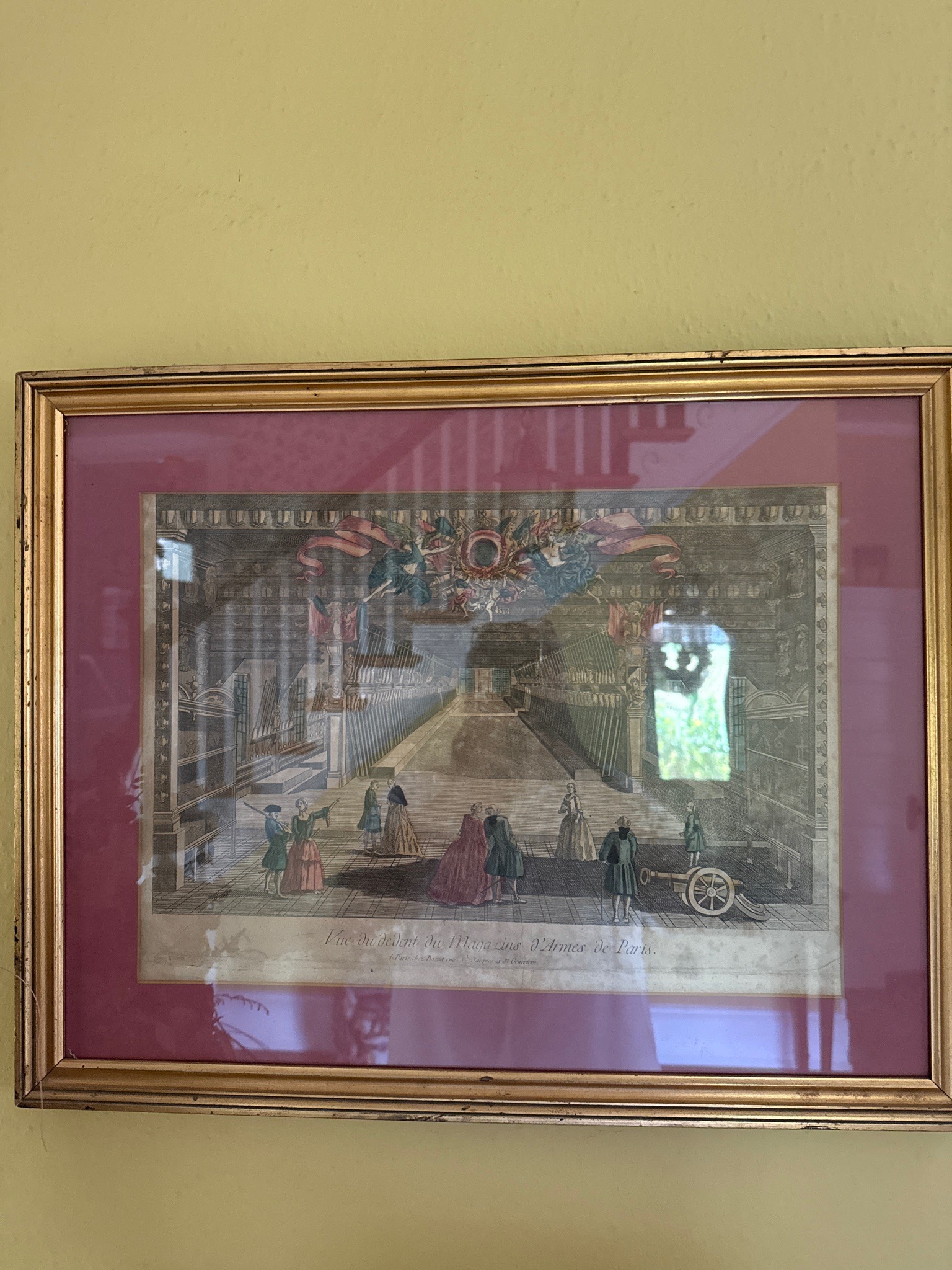
This item is a framed, hand-colored engraving depicting a vast interior armory. The print bears a French title at the bottom reading 'Vue du dedent du Magazins d'Armes de Paris' with smaller text below it likely indicating a publisher's address in Paris. The scene illustrates figures in 18th-century style dress strolling through a grand hall filled with racks of weaponry, architectural crests, and a cannon in the foreground. The composition is consistent with late 17th or early 18th-century perspectives, specifically in the manner of designers such as Jean Marot or similar illustrators of French royal sites. The colors appear to be hand-applied in muted tones of green, red, and blue. The work is housed in a modern-style gilt wood frame with a wide magenta or burgundy mat under glass. Condition-wise, there is visible yellowing and possible foxing Consistent with aged paper, along with some creasing or ripples in the sheet surface. The identification as an 18th-century work is a hypothesis based on stylistic elements and the legible French text; however, without physical examination, it is impossible to determine if this is a period impression or a later high-quality reproduction. The presence of significant glare on the glass obscures some finer line details, making a more specific attribution to a particular etcher difficult.

AI Appraisal Report

·AI can make mistakes·Verify before acting
Based on the provided image, I have examined this hand-colored engraving titled 'Vue du dedent du Magazins d'Armes de Paris.' The work follows the 18th-century French architectural tradition, likely a perspective view or 'vue d'optique' designed for viewing devices or decorative display. From what I can see, the composition and French text suggest a work in the style of Jean Marot or contemporary 18th-century publishers; however, I cannot verify from a photo whether this is a period impression from the original copper plate or a later 19th- or 20th-century reproduction. The visible yellowing, foxing, and paper rippling are consistent with age, but such features can also be present in later restrikes on aged paper. The appraisal value of $300–$600 assumes the hypothesis that this is a 18th-century period printing in fair condition. If physical inspection with a jeweler's loupe or microscope reveals a photomechanical dot pattern or lack of a plate mark, it would be considered a modern decorative reproduction, significantly reducing its value to approximately $50–$100. Market demand for 18th-century architectural prints remains steady among interior designers and collectors of French history, though the heavy magenta matting and modern frame may not appeal to all contemporary tastes. To confirm the piece's era and specific etcher, an in-person examination by a paper conservator or print specialist is necessary to review the paper's watermark, the indentation of the plate mark, and the nature of the ink and hand-coloring. Without such verification, this estimate remains a working hypothesis based on the stylistic elements visible in the digital image.

Get your items appraised

Instant estimates of your treasures with AI-powered appraisals

Browse More Appraisals