AI estimate as of July 18, 2025 · verify with a professional before acting
AI-Generated · Verify before acting
Everything on this page is generated by AI for informational purposes only. AI can make mistakes — the AI may misidentify items or misattribute them (artist, maker, brand, designer, origin, era). This is not an official valuation and should not be used for insurance, sale, tax, estate, legal, or lending purposes — or any decision requiring a certified appraisal. It is not an authoritative claim about any person, brand, or rights holder — do not share or rely on it as a factual statement about a third party. Always consult qualified professionals before making financial decisions.
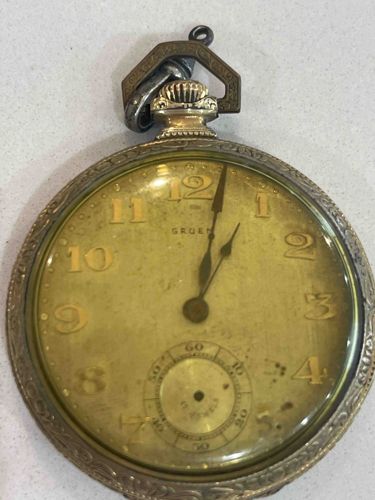
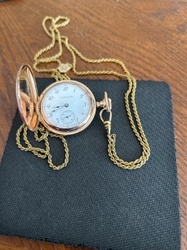
This item is a vintage Gruen pocket watch, likely dating from the early to mid-20th century, possibly the 1920s to 1940s based on its aesthetic and visible features. The watch features a round, metallic case with an ornate, possibly etched or engraved, patterned bezel and sides, indicating a decorative rather than purely functional design. The metal appears to be a silver-toned alloy, possibly white gold filled, nickel, or silver, exhibiting some tarnishing and wear consistent with age and use. The dial is a warm, golden-champagne color with applied or raised gold-toned Arabic numerals from 1 to 12, adding to its visual appeal and legibility. The '12' numeral is positioned at the top, and '6' is replaced by a sub-dial.
Two dark-toned, possibly blued steel or oxidized hands, an hour and minute hand, are visible, both with a spade or moon-style shape, indicating the time. Below the center hands, above the 6 o'clock position, the brand name 'GRUEN' is clearly visible in a simple, san-serif font. At the 6 o'clock position, there is a recessed sub-dial for the seconds hand, marked with increments of 10 from '10' to '60', and smaller minute/second markers. Within this sub-dial, faintly visible text appears to read '17 JEWELS', which speaks to the quality of the internal movement. The crystal covering the dial is clear but shows some minor surface imperfections and dust/debris underneath, typical for an older timepiece.
The watch is topped with an ornate, fluted or ribbed crown for winding and setting, which is gold-toned, contrasting with the main case. Attached to the crown is a hexagonal or octagonal bow (the top loop for attaching a chain), which also features intricate engraving or etching. Both the crown and the bow show significant wear and tarnishing, with the bow exhibiting a darker, almost blackened patina, suggesting a different metal or plating that has corroded significantly. The overall condition shows signs of age: the dial has developed some spotting and discoloration, and the case and bow exhibit patina and minor scratches. Despite the wear, the watch retains its form and key features, indicating reasonable craftsmanship for its era.
AI Appraisal Report
I have examined the provided image of the Gruen pocket watch with a gold-tone dial to provide this appraisal. Based on the aesthetic and visible features, particularly the dial markers, hand style, and case ornamentation, I concur with the assessment that it likely dates from the 1920s to 1940s. The 'GRUEN' signature and '17 JEWELS' visible on the sub-dial strongly suggest authenticity for a Gruen timepiece of this era. The metallic case, appearing to be silver-toned, possibly white gold filled, nickel, or silver, exhibits significant wear and tarnishing consistent with its age. The gold-toned Arabic numerals and sub-seconds dial are intact, enhancing legibility. The ornate fluted crown and hexagonal/octagonal bow, though showing considerable tarnish and wear, retain their design.
Market conditions for vintage Gruen pocket watches vary widely based on condition, rarity of movement, and case material. While Gruen produced many high-quality movements, this specific model appears to be a good, but not exceptionally rare, example from their production lines. The '17 JEWELS' count indicates a decent grade movement for the period, offering good timekeeping. Demand for vintage pocket watches is steady but not surging, with common models typically fetching lower prices, and higher-grade, rarer, or solid gold-cased examples commanding premiums. The overall condition, with visible spotting on the dial, surface imperfections on the crystal, and significant wear on the case and especially the bow, negatively impacts its collectible value. Patina is acceptable, but excessive wear and discoloration reduce desirability.
To fully authenticate this timepiece and accurately assess its value, an in-person examination would be crucial. This would allow for verification of the movement serial number to pinpoint the exact manufacturing date, confirm the jewel count definitively, assess the integrity of the movement, and identify the precise case material. Opening the case is necessary to confirm the type of movement and its condition. Furthermore, provenance documentation, such as original receipts or ownership history, could add significant value. Without physical inspection, I cannot confirm if the watch is currently running or its timekeeping accuracy, which are critical factors in valuation.