Category: Other
Material: Red Pine, Zelkova, Paulownia
Dimensions: 40Lx25Wx80H
Age: ~90-100 years
These notes were written by the person who submitted this item. Appraiser.AI has not verified them, and the AI's identification and estimate may rely on them.
AI Estimated Value
Not an official valuation
$1,200-$1,800
AI estimate as of November 22, 2026 · verify with a professional before acting
AI-Generated · Verify before acting
Everything on this page is generated by AI for informational purposes only. AI can make mistakes — the AI may misidentify items or misattribute them (artist, maker, brand, designer, origin, era). This is not an official valuation and should not be used for insurance, sale, tax, estate, legal, or lending purposes — or any decision requiring a certified appraisal. It is not an authoritative claim about any person, brand, or rights holder — do not share or rely on it as a factual statement about a third party. Always consult qualified professionals before making financial decisions.
This analysis also relies on unverified notes provided by the user, which may be incomplete or inaccurate and could affect the result.
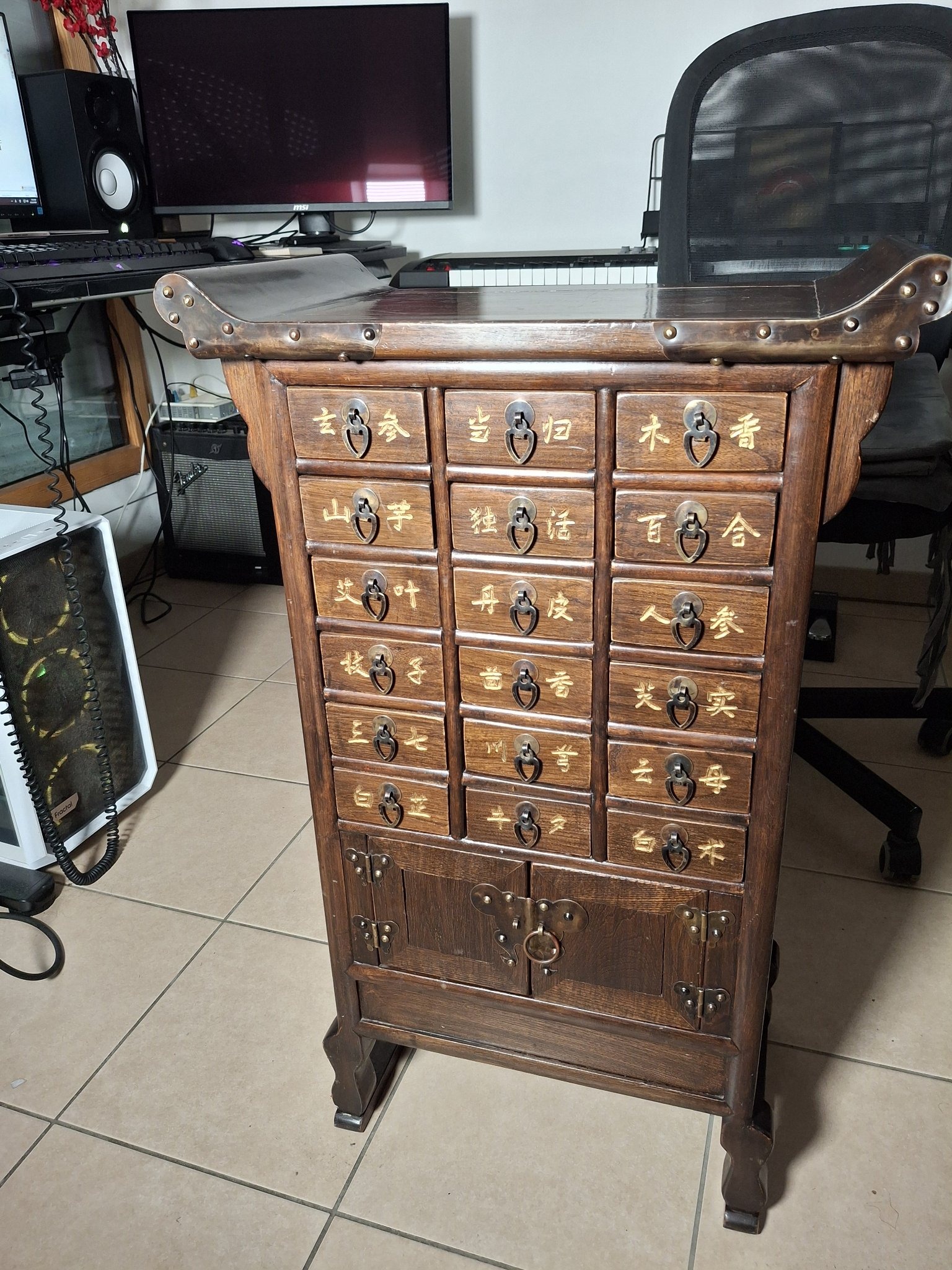
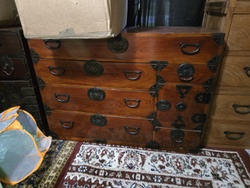
This is a wooden multi-drawer storage cabinet featuring a distinctive traditional East Asian design with a flared, flanged top resembling a scholar's desk or architectural roof structure, accented with brass-toned metal hardware. The piece presents a dark brown wood grain finish across its surface. The front of the cabinet is organized into eighteen small drawers arranged in three vertical columns of six rows, positioned above a lower two-door cabinet compartment. Each of the small drawers is fitted with a teardrop-shaped drop handle mounted on a decorative backplate and features hand-painted or inscribed gold-colored Chinese characters on the face, which are consistent with traditional herbal medicine labeling. The lower cabinet doors are secured with decorative metal hinges and a central latch plate with a circular pull ring. The cabinet stands on slightly flared, block-style feet. Visible condition appears generally well-maintained with normal minor surface wear and a varied patina consistent with vintage or antique furniture. The owner-supplied attribution notes the item as approximately 90 to 100 years old, constructed from materials including red pine, zelkova, and paulownia, though these specific material and age claims remain unverified by physical inspection. No visible maker's marks or stamps are apparent from the provided photograph, and the identification is based entirely on the visual typology of a traditional medicine chest. The quality indicators include traditional joinery cues and ornate metal hardware details typical of mid-20th-century or earlier regional craftsmanship.
AI Appraisal Report
Based on the visual evidence provided, I have evaluated this multi-drawer Asian apothecary cabinet. Per user submission, the piece is attributed as approximately 90 to 100 years old, constructed from red pine, zelkova, and paulownia. From what I can see, the cabinet features traditional eighteen-drawer configuration, brass-toned hardware, gold-colored herbal labeling, and a flared scholar's desk top. However, I cannot verify materials, joinery construction, or precise age from a photograph alone, and physical inspection is required to properly assess these aspects. Assuming the owner's attribution is correct, traditional medicine chests of this type and scale generally command moderate to strong interest in the antique market among collectors of Asian furnishings, driven by decorative appeal and functional form. The estimated value range reflects this assumed regional craftsmanship and vintage status. If physical inspection were to reveal the piece is a modern reproduction, decorative replica, or made 'in the style of' rather than an antique, the value would decrease significantly, likely dropping to the $300-$500 range. To confirm authenticity, age, and material composition, an in-person examination by a qualified furniture conservator or antiques specialist would be necessary, alongside closer analysis of the wood patination and hardware mounting.