AI estimate as of October 4, 2025 · verify with a professional before acting
AI-Generated · Verify before acting
Everything on this page is generated by AI for informational purposes only. AI can make mistakes — the AI may misidentify items or misattribute them (artist, maker, brand, designer, origin, era). This is not an official valuation and should not be used for insurance, sale, tax, estate, legal, or lending purposes — or any decision requiring a certified appraisal. It is not an authoritative claim about any person, brand, or rights holder — do not share or rely on it as a factual statement about a third party. Always consult qualified professionals before making financial decisions.
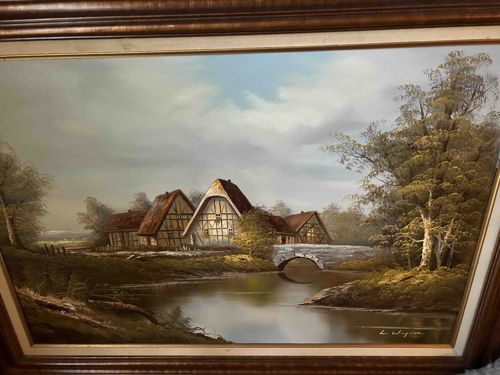
This item is an oil painting on canvas by the artist L. Waligora, depicting a tranquil European landscape. The painting features several timber-framed houses with thatched roofs, characteristic of traditional rural architecture, positioned along the banks of a calm river or stream. A stone arch bridge spans the waterway, connecting the foreground with the structures on the far bank. The immediate foreground shows shaded earthy tones leading to the water's edge, reflecting the muted sky above. Lush trees, including what appears to be a birch or similar deciduous tree with light bark on the right, frame the composition. The color palette is predominantly cool, with shades of grey and blue in the cloudy sky, contrasting with the warm browns and yellows of the house roofs and the green foliage. The artist employs visible brushstrokes, particularly in the trees and the textured appearance of the roofs, suggesting an impressionistic or post-impressionistic influence, though with a degree of realism in the architectural details. The painting is housed within a dark wooden frame with a decorative carved pattern, and an inner white liner, which serves to highlight the artwork. The overall condition appears good, with no overt signs of significant damage like tears, punctures, or extensive paint loss visible from the image. The signature 'L. Waligora' is discernible in the lower right corner. The painting evokes a sense of peaceful rural life, likely dating from the mid to late 20th century, given its style and framing.
AI Appraisal Report
I have examined the provided image of the L. Waligora oil painting depicting a European landscape with timber-framed houses and a bridge. Visually, the painting appears to be in good condition; I detect no overt signs of tears, punctures, extensive paint loss, or significant damage to the canvas or paint surface. The dark wooden frame with its decorative carving and inner white liner also appears intact, enhancing the presentation. The visible brushstrokes and subject matter align with a mid to late 20th-century impressionistic or post-impressionistic style. The signature 'L. Waligora' is clearly legible in the lower right corner.
Market conditions for works by artists without extensive auction records or significant institutional representation generally fall into the decorative arts category. While aesthetically pleasing, demand for such pieces is driven more by visual appeal and condition than by an artist's established market presence. Comparable sales for similar landscape oil paintings from the same period by lesser-known artists typically range in the low to mid-hundreds, depending on size, subject appeal, and overall execution.
Factors impacting value include the artwork's appealing subject matter, tranquil mood, and good condition. The lack of extensive public sales data for L. Waligora, however, limits its investment potential, placing it firmly in the decorative market. Rarity is difficult to assess without knowledge of the artist's total output, but visually, it does not present as a unique or groundbreaking piece.
It is crucial to note the limitations of image-based appraisal. Authenticity, while suggested by the signature, cannot be definitively confirmed without an in-person examination. A full authentication would require physical inspection to assess paint quality, substrate, and age characteristics consistent with the artist's known oeuvre. Furthermore, provenance documentation (e.g., bills of sale, exhibition history) would be essential to verify the artwork's history and establish a more robust authentication. Scientific testing on paint composition or dating methods could also provide further verification.