AI Appraisal Estimate

AI-generated estimates · not official valuations

From the user

What was submitted

Photo and notes provided by the user — not generated by AI

Submitted item photo
Submitted photo · June 17, 2026

User's notes

No additional notes provided.

AI analysis below

AI appraisal

AI analysis & estimate

AI-Generated · Verify before acting

Everything below is generated by AI for informational purposes only. AI can make mistakes — the AI may misidentify items or misattribute them (artist, maker, brand, designer, origin, era). This is not an official valuation and should not be used for insurance, sale, tax, estate, legal, or lending purposes — or any decision requiring a certified appraisal. It is not an authoritative claim about any person, brand, or rights holder — do not share or rely on it as a factual statement about a third party. Always consult qualified professionals before making financial decisions.

Read the full disclaimer

AI Identification

·Not independently authenticated·Verify before acting

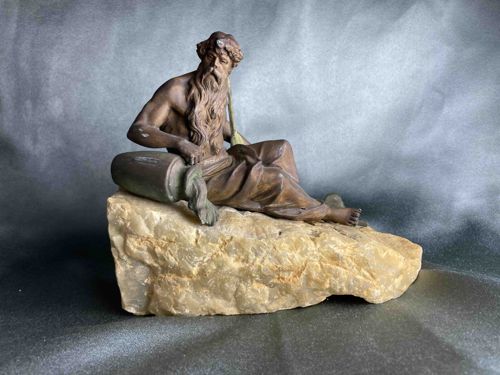
Neoclassical Bronze Figural Allegory of a River God on Alabaster Base

Fine Art - Sculpture

AI Estimated Value

·Not an official valuation·Verify before acting

$1,800 - $2,500

As of June 17, 2026

AI Item Analysis

·AI can make mistakes·Verify before acting
This is a detailed figural sculpture depicting a bearded River God, an allegorical figure often associated with classical mythology. The figure is masterfully cast in bronze with a rich, dark brown patina featuring subtle verdigris highlights, particularly near the overturned urn from which stylized water flows. The deity is portrayed reclining in a traditional semi-nude pose, draped in classical robes around the waist and legs. He features a long, flowing beard and hair, with an intense facial expression characteristic of 19th-century Neoclassical or Romantic styles. The bronze figure is mounted atop a heavy, ruggedly carved naturalistic base of light-colored alabaster or similar translucent quartz-like stone, which serves to simulate a rocky outcrop. Physically, the bronze exhibits high-quality anatomical detailing and fine textile folds. Notable condition issues include a circular silver-colored blemish or loss of patina on the figure's forehead and right bicep, along with minor surface abrasions and dust accumulation in the crevices. The style suggests a late 19th-century European origin, possibly French, used as a library ornament or mantle piece. The craftsmanship shows professional foundry work with attention to musculature and realistic proportion.

AI Appraisal Report

·AI can make mistakes·Verify before acting
I have conducted a visual examination of the Neoclassical Bronze Figural Allegory of a River God. This work displays the hallmarks of late 19th-century French foundry excellence, characterized by high-quality chasing and a complex dark brown patina with integrated verdigris. The anatomical precision and the contrast between the fluid bronze casting and the rugged, translucent alabaster base suggest a professional atelier production intended for the high-end Grand Tour or library décor market. The condition is generally good, though I noted a circular loss of patina on the forehead and bicep—likely a result of chemical oxidation or localized abrasion—which moderately impacts the aesthetic continuity. Market demand for Neoclassical allegories remains steady among collectors of European bronzes. Comparable sales of unsigned but high-quality mid-to-large scale 19th-century river god figures typically fall within the $1,500 to $3,000 range, depending on the foundry mark. The rarity of this piece is bolstered by its unique stone base, though the lack of a visible signature or foundry seal (e.g., Barbedienne or Susse Frères) necessitates a more conservative valuation. Limitations: This appraisal is based solely on digital images. Without physical inspection, I cannot verify the bronze's density, the presence of internal foundry markings, or the authenticity of the stone-to-metal mounting. A full authentication requires an in-person examination to check for 'felt-tip' cold-painting (which would decrease value) versus true fire-gilding or chemical patination. Furthermore, provenance documentation or a bill of sale from a recognized 19th-century dealer would be required to firmly establish its historical origin and potentially increase this valuation.

Get your items appraised

Instant estimates of your treasures with AI-powered appraisals

Browse More Appraisals