AI Appraisal Estimate

AI-generated estimates · not official valuations

From the user

What was submitted

Photo and notes provided by the user — not generated by AI

Submitted item photo
Submitted photo · June 6, 2026

User's notes

No additional notes provided.

AI analysis below

AI appraisal

AI analysis & estimate

AI-Generated · Verify before acting

Everything below is generated by AI for informational purposes only. AI can make mistakes — the AI may misidentify items or misattribute them (artist, maker, brand, designer, origin, era). This is not an official valuation and should not be used for insurance, sale, tax, estate, legal, or lending purposes — or any decision requiring a certified appraisal. It is not an authoritative claim about any person, brand, or rights holder — do not share or rely on it as a factual statement about a third party. Always consult qualified professionals before making financial decisions.

Read the full disclaimer

AI Identification

·Not independently authenticated·Verify before acting

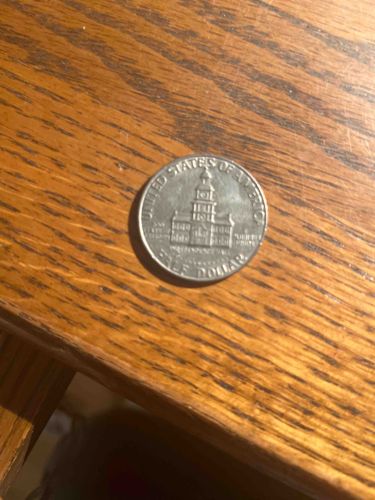
United States Half Dollar (Reverse)

Coin

AI Estimated Value

·Not an official valuation·Verify before acting

$10-25

As of June 6, 2026

AI Item Analysis

·AI can make mistakes·Verify before acting
This item is a United States Half Dollar coin, specifically the reverse side. The coin appears to be made of a silver-colored metal, likely a silver alloy given the typical composition of older US half dollars, though without a clear date, a precise material cannot be confirmed. The diameter is consistent with a standard half dollar. The central motif on the reverse is an architectural rendering of Independence Hall, a prominent historical building with a symmetrical facade, multiple windows, and a distinctive clock tower at its center. Above the building, the inscription "UNITED STATES OF AMERICA" is clearly visible in an arc. Below the building, the denomination "HALF DOLLAR" is inscribed. The coin exhibits a moderate amount of wear consistent with circulation, particularly on the raised elements of the building and the lettering, which show some softening of detail. There are no obvious signs of significant damage like deep scratches or significant discoloration, but a subtle, somewhat muted luster suggests a natural patina rather than recent cleaning. The overall craftsmanship appears to be of standard mint quality for a circulating coin of its presumed era. Without the obverse or a clearer view of the mint mark or year, specific manufacturing details or an exact age cannot be determined, but the design points to a mid-20th century era, likely a Franklin Half Dollar (1948-1963), which notably features Independence Hall on its reverse.

AI Appraisal Report

·AI can make mistakes·Verify before acting
I have examined the provided image of the reverse side of a United States Half Dollar. Based on the depiction of Independence Hall, this is almost certainly a Franklin Half Dollar, minted between 1948 and 1963. The coin appears authentic, consistent with known examples of this type. The wear is moderate, suggesting a grade in the Fine (F) to Very Fine (VF) range. Details on Independence Hall show softening, and some of the lettering exhibits wear, but major elements are still discernible. The absence of significant scratches or environmental damage is a positive, and the muted luster indicates a natural patina, which is preferable to evidence of cleaning. Market conditions for Franklin Half Dollars are generally stable. Their value is primarily driven by their silver content and collector demand for specific dates, mint marks, and higher grades. Given the circulated condition, this coin's value is largely tied to its silver melt value, with a slight premium for its numismatic appeal. Stronger demand exists for uncirculated examples or key dates/mint marks, which cannot be determined from this single image. While Franklin Half Dollars are not rare, they remain popular among collectors. Limitations regarding authenticity verification from an image alone are significant. I cannot confirm the metal composition, weight, or precise dimensions. A physical examination would allow for weigh-ins, diameter checks, and detailed inspection under magnification for counterfeiting indicators. Viewing the obverse would be crucial for identifying the date and mint mark, which are vital for pinpointing specific rarity or premium value. Without this, I must base my appraisal on the general series and visible condition, assuming no major hidden flaws or a rare date.

Get your items appraised

Instant estimates of your treasures with AI-powered appraisals

Browse More Appraisals