AI estimate as of September 3, 2025 · verify with a professional before acting
AI-Generated · Verify before acting
Everything on this page is generated by AI for informational purposes only. AI can make mistakes — the AI may misidentify items or misattribute them (artist, maker, brand, designer, origin, era). This is not an official valuation and should not be used for insurance, sale, tax, estate, legal, or lending purposes — or any decision requiring a certified appraisal. It is not an authoritative claim about any person, brand, or rights holder — do not share or rely on it as a factual statement about a third party. Always consult qualified professionals before making financial decisions.
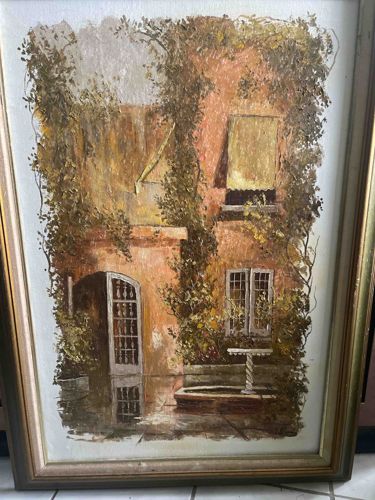
This is an oil painting depicting an idyllic Mediterranean or European courtyard scene. The canvas, rendered primarily with oil paints, features a rich impasto technique, particularly noticeable in the foliage and the textured walls, giving the artwork a three-dimensional quality. The primary colors are warm earth tones: a dominant terracotta or salmon pink for the building facade, various shades of green and brown for the abundant climbing vines and shrubbery, and hints of yellow and white for details like window sills and reflective surfaces. The composition centers on an old building heavily draped in vines, featuring an arched doorway on the left and a window with an awning and another window below, surrounded by greenery. In the foreground, there's a stone-like basin or fountain with a small columnar sculpture or bird bath, implying a water feature, with reflections suggesting a wet or cobblestone ground characteristic of a courtyard after rain or with a fountain. The painting is housed in a simple, traditional frame, likely made of wood, with a gold or brass-toned finish showing some signs of wear or patina consistent with its age, possibly late 20th century. There are no visible artist's signatures or prominent manufacturing marks. The overall condition appears good, with no obvious signs of significant damage such as tears, punctures, or extreme paint loss, though minor surface dirt or age-related subtle crackling might be present upon closer inspection. The craftsmanship is decent, the impasto adds interest and depth, and the subject matter is classic and appealing.
AI Appraisal Report
Based on my visual examination of the provided image of the 'Mediterranean Courtyard Scene' oil painting, I assess its overall condition to be good. The rich impasto technique, particularly in the foliage and walls, is well-preserved, showing no obvious signs of significant damage like tears, punctures, or substantial paint loss. Minor surface dirt or subtle age-related crackling might be present, but these are typical and expected for a piece of this presumed vintage, likely late 20th century. The simple, traditional frame with its gold/brass-toned finish appears consistent with the painting's style and age, showing appropriate wear.
From images alone, authenticity verification is inherently limited. I see no visible artist's signature or prominent manufacturing marks, making attribution impossible at this stage. Without physical inspection, I cannot definitively confirm the medium as oil paint, although the visual characteristics strongly suggest it. To fully verify its authenticity and medium, an in-person examination would be crucial to assess paint layers, canvas weave, and pigment consistency. Provenance documentation, if available, would be invaluable for establishing its history and potential artist. Scientific testing, such as pigment analysis, could confirm the medium and age more precisely.
In terms of market conditions, Mediterranean courtyard scenes are generally appealing to a broad audience, contributing to a steady but not exceptionally high demand. The lack of an identifiable artist or remarkable rarity places it within the decorative art market. Comparable unsigned, decorative oil paintings of this size and subject typically range in the low to mid-hundreds. Factors significantly impacting its value include the unknown artist and the generic nature of the scene, preventing it from commanding higher prices associated with established artists or unique artistic merit. The good condition and appealing subject matter are positive, but the absence of provenance or an artist's signature caps its potential value.