AI estimate as of October 2, 2025 · verify with a professional before acting
AI-Generated · Verify before acting
Everything on this page is generated by AI for informational purposes only. AI can make mistakes — the AI may misidentify items or misattribute them (artist, maker, brand, designer, origin, era). This is not an official valuation and should not be used for insurance, sale, tax, estate, legal, or lending purposes — or any decision requiring a certified appraisal. It is not an authoritative claim about any person, brand, or rights holder — do not share or rely on it as a factual statement about a third party. Always consult qualified professionals before making financial decisions.
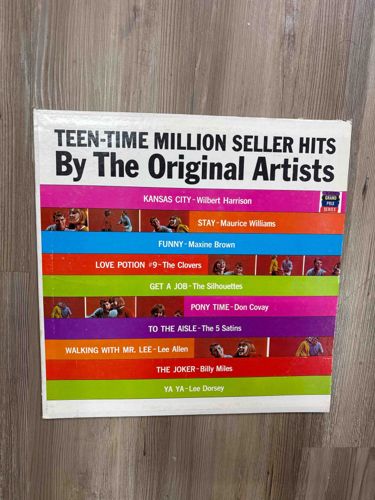
This item is a vintage vinyl record album, likely a 12-inch LP, titled "Teen-Time Million Seller Hits By The Original Artists." The front cover design is characterized by a white border enclosing a colorful, horizontally segmented layout. The title text is presented in a bold, sans-serif font, primarily in black, with 'TEEN-TIME MILLION SELLER HITS' and 'By The Original Artists' prominently displayed. Below the title, the tracklist is arranged in distinct horizontal color bands, each featuring the song title and original artist, along with small, often blurry, photographic or illustrated images associated with the music or artists. Visible artists and songs include 'KANSAS CITY - Wilbert Harrison', 'STAY - Maurice Williams', 'FUNNY - Maxine Brown', 'LOVE POTION #9 - The Clovers', 'GET A JOB - The Silhouettes', 'PONY TIME - Don Covay', 'TO THE AISLE - The 5 Satins', 'WALKING WITH MR. LEE - Lee Allen', 'THE JOKER - Billy Miles', and 'YA YA - Lee Dorsey'. A small 'GRAND PRIZE SERIES' logo is visible on the right side of the cover. The album cover appears to be made of standard cardboard with a glossy finish. The edges show some signs of wear typical for its age, including slight corner rounding and possibly some surface scuffs, though no major rips or significant damage are clearly discernible from the provided image. The overall condition suggests a well-preserved piece of music memorabilia, likely from the late 1950s or early 1960s, given the artists and 'teen-time' theme. The colorful design and historical tracklisting make it a notable piece for collectors of vintage pop and rock and roll music.
AI Appraisal Report
I have carefully examined the provided image of the 'Teen-Time Million Seller Hits By The Original Artists' (Grand Prix Series) vinyl record album. Visually, the album cover appears to be in Good to Very Good condition for its age. I note the expected corner rounding, some minor surface scuffs, and possibly slight edge wear, but no major rips or egregious damage are discernible. The colors remain vibrant. Authenticity, based solely on this image, appears consistent with genuine albums from the late 1950s to early 1960s; the Grand Prix Series was a known budget label. However, without inspecting the vinyl itself (condition of the record, inner sleeve, labels, matrices) and the internal structure of the cover, a definitive assessment of authenticity and overall condition is limited. In-person examination would be required to check for seam splits, ring wear, writing on the cover, actual vinyl condition (scratches, warps), and label integrity. Market conditions for these various artist compilation albums, even with 'original artists,' are generally moderate unless they contain rare tracks or are in Near Mint condition. Demand is typically from collectors of 50s/60s pop/R&B or general vinyl enthusiasts. Rarity is low; many such compilations were pressed. The key factors impacting value are the actual playability and visual grade of the vinyl and the presence of any unique pressings. Without physically inspecting the record itself, confirming play grade, and checking for variations, this valuation is based primarily on the cover's apparent condition and the commonality of such releases. For full authentication, I'd need to physically inspect the record's run-out grooves, label variations, and examine the cover for precise condition and any hidden damage.