AI estimate as of December 10, 2025 · verify with a professional before acting
AI-Generated · Verify before acting
Everything on this page is generated by AI for informational purposes only. AI can make mistakes — the AI may misidentify items or misattribute them (artist, maker, brand, designer, origin, era). This is not an official valuation and should not be used for insurance, sale, tax, estate, legal, or lending purposes — or any decision requiring a certified appraisal. It is not an authoritative claim about any person, brand, or rights holder — do not share or rely on it as a factual statement about a third party. Always consult qualified professionals before making financial decisions.
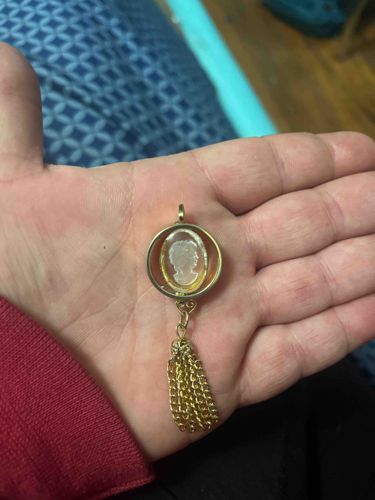
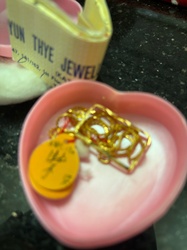
This item is a gold-toned pendant featuring a central cameo element and a dangling tassel. The pendant is constructed with a main, presumably base metal with gold-tone plating, forming a circular frame. Within this frame, set slightly recessed, is an oval-shaped cameo. The cameo itself appears to be made from a translucent, light-colored material, possibly glass or plastic, with a white, opaque relief carving of a woman's profile facing right. The detail on the cameo is somewhat subtle, suggesting a classical or neoclassical style often seen in such pieces. The gold-toned frame surrounding the cameo has a smooth, polished finish. Attached to the bottom of the main circular frame is a smaller, ornate gold-toned bail orconnector piece with scroll-like embellishments. From this connector hangs a tassel component, composed of multiple strands of fine, gold-toned chain. The chains are gathered at the top, forming a dense, flowing tassel approximately 2-3 cm in length. At the very top of the main circular frame is a simple, closed bail for attaching the pendant to a chain or necklace. The overall condition appears good with no significant visible damage such as dents, scratches, or missing chains on the tassel, though some minor wear or tarnishing might be present on closer inspection due to its age and handling. This type of pendant, combining a cameo with a tassel, suggests an estimated age from the mid-20th century, possibly 1960s-1980s, when such detailed costume jewelry was popular. The craftsmanship appears to be commercially manufactured, with a focus on decorative visual appeal rather than precious materials.
AI Appraisal Report
I have examined the provided image of this Gold-Toned Cameo Tassel Pendant. Based on my visual assessment, the item presents in good overall condition, showing no significant visible damage such as heavy dents, deep scratches, or missing tassel strands. The gold-toned plating appears largely intact. Authenticity, based solely on imagery, points towards this being a commercially manufactured costume jewelry piece from the mid-20th century, likely 1960s-1980s, given the stylistic combination of a classical cameo and a tassel, which was popular during that period. The cameo material appears to be glass or plastic, not natural shell or stone, further supporting its classification as costume jewelry.
Market conditions for vintage costume jewelry of this nature are generally moderate. While there is a consistent collector base, pieces made from base metals and synthetic materials typically command lower values compared to fine jewelry. Comparables for similar gold-toned cameo pendants with tassel elements, often found on online marketplaces and at antique malls, usually fall within a modest price range. Demand is stable but not exceptionally high, and such pieces are not considered rare. The primary factor impacting value is its decorative appeal and condition.
Limitations in authenticity verification from images alone are significant. While the visual cues suggest costume jewelry, an in-person examination would be crucial to confirm the material composition of the cameo (e.g., distinguishing glass from plastic definitively), assess the quality and integrity of the gold-tone plating, identify any maker's marks or hallmarks that might be present but are not visible in the image, and detect subtle wear or tarnishing that could affect value. Scientific testing could conclusively identify metals and cameo material, while provenance documentation would offer historical context, neither of which are available here. Without these, the appraisal remains an informed estimate based on visual evidence typical of such items.