These notes were written by the person who submitted this item. Appraiser.AI has not verified them, and the AI's identification and estimate may rely on them.
AI Estimated Value
Not an official valuation
$10-30
AI estimate as of July 11, 2025 · verify with a professional before acting
AI-Generated · Verify before acting
Everything on this page is generated by AI for informational purposes only. AI can make mistakes — the AI may misidentify items or misattribute them (artist, maker, brand, designer, origin, era). This is not an official valuation and should not be used for insurance, sale, tax, estate, legal, or lending purposes — or any decision requiring a certified appraisal. It is not an authoritative claim about any person, brand, or rights holder — do not share or rely on it as a factual statement about a third party. Always consult qualified professionals before making financial decisions.
This analysis also relies on unverified notes provided by the user, which may be incomplete or inaccurate and could affect the result.
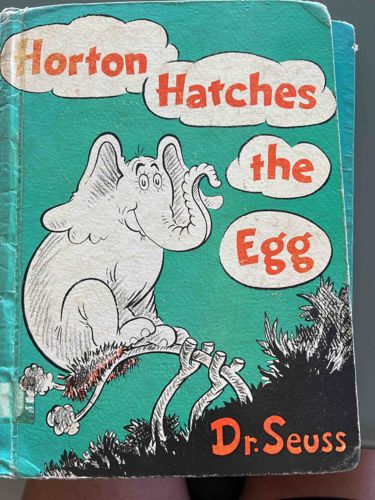
This item is a copy of the children's book "Horton Hatches the Egg" by Dr. Seuss (Theodor Seuss Geisel). The book features a softcover binding, likely a paperback edition, given its flexible appearance. The cover design is iconic, showcasing a stylized illustration of Horton the elephant with distinct large ears, trunk, and black outline. He is depicted perched on a tree branch, which is rendered in black and thin white lines, against a vibrant turquoise background. The title "Horton Hatches the Egg" is prominently displayed in orange text within white, cloud-shaped speech bubbles. The author's name, "Dr. Seuss," is at the bottom right in orange lettering against a black silhouette of grass or foliage, typical of his unique artistic style.
Regarding condition, the book shows significant signs of wear consistent with age and use. The corners are rounded and show creasing, particularly the top left which appears scuffed. The edges of the cover are visibly worn, with the turquoise color fading and showing scuffs, revealing the lighter material underneath. There are visible scuff marks and discoloration on the top left cloud containing the word "Horton," suggesting adhesive residue or significant handling. Faint lines or indentations are visible across the cover, typical of a well-read book. Despite the wear, the cover illustration remains largely intact and recognizable, characteristic of Dr. Seuss's mid-20th-century work. This specific style of illustration and typography is indicative of Dr. Seuss's publications, likely dating from the mid-1940s to the second half of the 20th century. The quality of the paper and printing, while showing its age, reflects mass-produced children's literature of that era. There are no visible maker's marks besides the author's name on the cover, which is standard for book identification.
AI Appraisal Report
I have examined the provided image of "Horton Hatches the Egg" by Dr. Seuss. This appears to be a softcover edition, exhibiting significant wear consistent with a frequently read children's book. The rounded and scuffed corners, faded edges, and visible scuffing/discoloration on the cover, particularly around the "Horton" text, indicate considerable handling. Despite the wear, the iconic Dr. Seuss illustration and typography remain largely intact and recognizable, placing its likely publication between the mid-1940s and the end of the 20th century.
Authenticity, based solely on the image, appears to be that of a genuine copy of the book. However, without physical examination, I cannot confirm details such as specific printing edition (first edition vs. later printings), internal page condition, binding integrity, or the presence of any inscriptions or marks which significantly impact value. Marker tests for paper age or closer inspection of print quality would inform a more precise dating.
Regarding market conditions, "Horton Hatches the Egg" is a beloved and popular title. While first editions, especially in hardcover and good condition, can fetch substantial prices (hundreds to thousands of dollars), softcover editions, particularly those showing significant wear, command much lower values. Demand for Dr. Seuss's work is consistently high, but this specific copy's condition is a major limiting factor. Similar worn softcover copies typically sell in the low tens of dollars. If this were a very early softcover printing that is exceedingly rare, its value could be slightly higher, but its condition would still heavily depress market interest for serious collectors.
Given the visible wear and its softcover format, which suggests it is not a first edition high-value collectible, I can confidently assess its current market value based on direct observation.
Limitations: A definitive authentication of the precise edition, and thus a more accurate valuation, would require physical examination of the copyright page, endpapers, paper quality, and binding. Provenance documentation (e.g., proof of purchase, chain of ownership) would also enhance certainty regarding its history and potentially its value if it were an early or significant copy.