AI estimate as of June 22, 2025 · verify with a professional before acting
AI-Generated · Verify before acting
Everything on this page is generated by AI for informational purposes only. AI can make mistakes — the AI may misidentify items or misattribute them (artist, maker, brand, designer, origin, era). This is not an official valuation and should not be used for insurance, sale, tax, estate, legal, or lending purposes — or any decision requiring a certified appraisal. It is not an authoritative claim about any person, brand, or rights holder — do not share or rely on it as a factual statement about a third party. Always consult qualified professionals before making financial decisions.
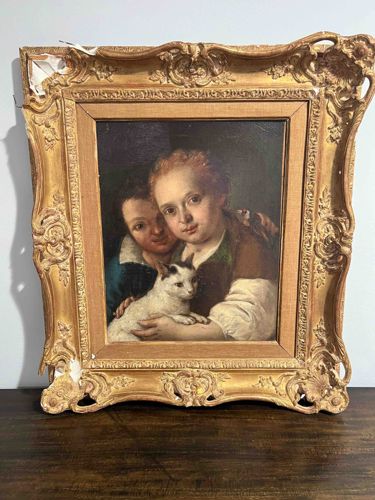
This item is an oil painting depicting two young children and a white cat, enclosed within an ornate, gilded frame. The painting itself shows two figures, likely siblings, with one slightly behind the other. The foreground figure, appearing to be a girl, has reddish hair and fair skin, maintaining direct eye contact with the viewer. She cradles a white cat with distinctive darker markings on its ears and tail, characteristic of a Siamese or similar breed. The background figure, possibly a boy, has dark hair and a more subdued expression. The children's attire appears to be of an earlier period, suggestion an age no newer than 19th Century. The predominant colors in the painting are earthy tones, including greens, browns, and blues in their clothing, contrasting with the lighter skin tones and the white of the cat's fur. The style suggests a classical or perhaps early romantic period, with soft brushstrokes and an emphasis on the subjects' expressions. The frame is a highly decorative, gold-colored piece, possibly gesso over carved wood, exhibiting intricate scrollwork and floral motifs. Its style is indicative of Rococo or Baroque influences, common in 18th or 19th-century framing. Condition issues include significant damage to the frame in multiple corners, particularly the upper left and lower left, where large sections of the decorative gesso and gilding have chipped away, revealing the underlying material. There are also smaller chips and abrasions throughout the gilded surface. The painting itself shows some signs of age, with possible craquelure visible upon closer inspection, though no major tears or punctures are apparent from this distance. The surface of the painting likely exhibits a patinated appearance consistent with age. No discernible artist's signature or maker's marks are visible on the front of the painting or frame. This piece demonstrates a good level of craftsmanship in both the painted portraiture and the detailed frame design, typical of period artworks.
AI Appraisal Report
This oil painting of children with a cat in an ornate gilded frame has been examined based on the provided image. The painting, depicting two children and a white cat, appears to be from the 19th century, suggested by the children's attire and the classical/early romantic artistic style with soft brushstrokes and earthy tones. The ornate gilded frame exhibits Rococo or Baroque influences.The condition of the frame significantly impacts its value; there are prominent chips and losses to the gesso and gilding, particularly in the upper and lower left corners. The painting itself shows signs of age, consistent with craquelure, but no major tears or punctures are visible. Without a physical inspection, however, the full extent of the craquelure or other surface issues such as grime or previous restorations cannot be accurately assessed. The absence of a visible artist's signature or maker's mark limits definitive attribution.While there's a steady market for period portraiture, particularly with engaging subjects like children and animals, the unknown artist, coupled with the frame's condition, prevents a higher valuation. Comparables of unsigned 19th-century portraits of similar quality typically fetch modest prices unless a significant provenance or verifiable artist emerges.Demand for such pieces is present but not exceptionally high. The rarity is moderate; similar framed portraits from the era are available, though the specific subject matter with the cat adds some unique appeal.To fully authenticate and establish provenance, an in-person examination is crucial to inspect the verso for any hidden marks, analyze paint layers, and assess the true condition of both the canvas and paint surface. Scientific testing, such as pigment analysis, could further confirm the period, and conservation assessment would determine the cost of restoration, which would need to be factored into any future valuation. Provenance documentation, if available, would significantly enhance the piece's value. Based on the visual information alone, this item falls into a decorative arts category rather than a fine art masterpiece without further authentication.