AI estimate as of July 20, 2025 · verify with a professional before acting
AI-Generated · Verify before acting
Everything on this page is generated by AI for informational purposes only. AI can make mistakes — the AI may misidentify items or misattribute them (artist, maker, brand, designer, origin, era). This is not an official valuation and should not be used for insurance, sale, tax, estate, legal, or lending purposes — or any decision requiring a certified appraisal. It is not an authoritative claim about any person, brand, or rights holder — do not share or rely on it as a factual statement about a third party. Always consult qualified professionals before making financial decisions.
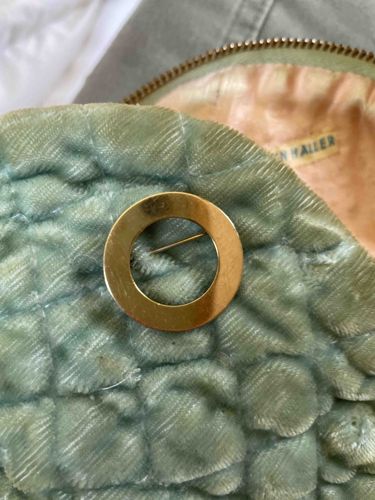
The item is a round, flat brooch with a highly polished, reflective gold-tone finish. It is minimalist in design, featuring a simple circular shape with a central circular cut-out, creating a uniform band. Its dimensions appear to be consistent, suggesting a well-formed piece. Visible on the reverse side of the brooch, or at least from the perspective of the image, is a straight pin mechanism for attachment, indicating its function as a brooch or pin. The main body of the brooch exhibits some minor surface wear and possibly some light tarnishing or discoloration, evident as darker spots or smudges, particularly towards the upper left quadrant of the ring. However, the overall reflective quality suggests the metal is still relatively well-maintained. The construction appears sturdy, with clean edges and a smooth surface. There are no readily visible maker's marks, signatures, or stamps in the provided image. Given its simple, geometric form, this piece likely dates from the mid-20th century to contemporary times, possibly aligning with modernist or minimalist design trends. The quality of craftsmanship appears to be good, with a precisely cut form and a functional pin mechanism. The brooch is displayed resting on a pale green, possibly velvet or velour, quilted surface, which appears to be part of a jewelry box or pouch, subtly labeled 'N KALLER' or 'N WALLER' inside.
AI Appraisal Report
Upon examining the provided image of the gold-tone circular brooch, I've assessed its condition and potential value. The brooch presents as a well-formed, minimalist piece with a polished gold-tone finish and a central circular cut-out. Its overall reflective quality suggests good maintenance, though minor surface wear, light tarnishing, or smudges are visible, particularly in the upper left quadrant. The reverse side clearly shows a functional straight pin mechanism.
Authenticity, based solely on visual examination, is challenging. The absence of readily visible maker's marks, signatures, or stamps prevents conclusive authentication from the image alone. The simple, geometric form points to a possible mid-20th century to contemporary origin, aligning with modernist or minimalist design trends. Without hallmarks, it's impossible to determine the metal composition (e.g., solid gold, gold-filled, plated base metal).
Market conditions for unmarked, gold-tone costume jewelry of this nature are generally modest. Comparables would include similar geometric brooches from the mid-century onward, often ranging from utilitarian costume pieces to more refined, unsigned designer items. Demand for this specific type of minimalist brooch is steady but not exceptional, unless attributed to a known designer or made of precious metal.
The primary factor significantly impacting value is the undetermined metal content. If it were confirmed to be solid gold or a high-karat gold-filled piece by a reputable maker, its value would increase substantially. However, as unmarked gold-tone, it is presumed to be costume jewelry.
Limitations in authenticity verification from images are severe. For full authentication and accurate appraisal, an in-person examination is crucial. This would allow for: 1. Spectroscopic analysis or acid testing to determine metal composition. 2. Close inspection for faint or hidden maker's marks. 3. Assessment of construction quality under magnification. 4. Evaluation of the pin mechanism for specific design characteristics. Provenance documentation (e.g., original purchase receipts, designer attributions) would also be highly beneficial.