AI Appraisal Estimate

AI-generated estimates · not official valuations

From the user

What was submitted

Photo and notes provided by the user — not generated by AI

Submitted item photo
Submitted photo · June 13, 2026

User's notes

No additional notes provided.

AI analysis below

AI appraisal

AI analysis & estimate

AI-Generated · Verify before acting

Everything below is generated by AI for informational purposes only. AI can make mistakes — the AI may misidentify items or misattribute them (artist, maker, brand, designer, origin, era). This is not an official valuation and should not be used for insurance, sale, tax, estate, legal, or lending purposes — or any decision requiring a certified appraisal. It is not an authoritative claim about any person, brand, or rights holder — do not share or rely on it as a factual statement about a third party. Always consult qualified professionals before making financial decisions.

Read the full disclaimer

AI Identification

·Not independently authenticated·Verify before acting

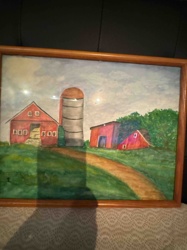
Winter Mountain Landscape Painting by Robert J. Manuel

Fine Art - Paintings

AI Estimated Value

·Not an official valuation·Verify before acting

$100.00-$175.00

As of June 13, 2026

AI Item Analysis

·AI can make mistakes·Verify before acting
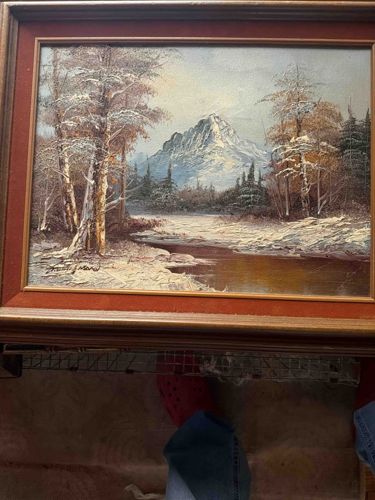
This is an original framed oil painting on canvas by artist Robert J. Manuel, depicting a serene winter landscape. The composition features a prominent snow-capped mountain peak as the central focal point, framed by autumnal trees dusted in snow and a winding river in the foreground. The color palette is dominated by cool blues and whites in the mountains, contrasted with warm ochre and burnt siennas in the lakeside foliage. Technically, the work is executed with heavy impasto techniques, particularly visible in the thick application of white paint to represent snow on the ground and branches, adding physical texture and dimension to the scene. The painting is signed in the lower left corner in a dark pigment. It is housed in an ornate, multi-tiered vintage frame consisting of a stained wood outer molding, a burnt-orange velvet linen liner, and a thin gold-toned inner fillet. The style is characteristic of late 20th-century decorative landscape art, often associated with the Bob Ross-influenced wet-on-wet technique popular for domestic decor. The condition appears fair to good locally, though there is visible dust accumulation on the frame and the linen liner shows some fading and typical age-related wear. The craftsmanship represents a commercial/decorative level of art production common to the 1970s or 1980s.


AI Appraisal Report

·AI can make mistakes·Verify before acting
I have virtually examined this framed landscape oil on canvas attributed to Robert J. Manuel. The work is characteristic of decorative landscape painting from the mid-to-late 20th century, specifically utilizing 'wet-on-wet' techniques popularized during the 1970s and 80s. The heavy impasto work provides a pleasing tactile quality, though the composition follows a formulaic commercial structure typical of décor art intended for home furnishings rather than gallery-tier fine art. Condition-wise, the canvas appears stable, but the framing shows significant age-related wear. The burnt-orange velvet liner is dated and shows signs of fading, while the accumulation of debris suggests a lack of climate-controlled storage. Authenticity is based on the visible signature, which matches known examples of Manuel’s commercial output. Market demand for this specific style has softened considerably since its peak, as contemporary tastes have shifted away from ornate vintage 'couch paintings' toward minimalist or modern styles. Comparable sales for similar works by Manuel and his contemporaries in secondary markets (auctions/estate sales) typically fall within the $75 to $200 range. Limitations of this appraisal include the inability to inspect the verso for canvas stamps, stretch marks, or manufacturer labels that could more accurately date the piece. A physical examination would be required to rule out the use of a 'starved' oil surface or hidden craquelure. Furthermore, while the style is consistent with the artist, full authentication would require provenance documentation or a forensic analysis of the pigments to confirm the era of production. The current value is primarily driven by the decorative appeal and the frame, rather than investment-grade rarity.

Get your items appraised

Instant estimates of your treasures with AI-powered appraisals

Browse More Appraisals