AI estimate as of September 11, 2025 · verify with a professional before acting
AI-Generated · Verify before acting
Everything on this page is generated by AI for informational purposes only. AI can make mistakes — the AI may misidentify items or misattribute them (artist, maker, brand, designer, origin, era). This is not an official valuation and should not be used for insurance, sale, tax, estate, legal, or lending purposes — or any decision requiring a certified appraisal. It is not an authoritative claim about any person, brand, or rights holder — do not share or rely on it as a factual statement about a third party. Always consult qualified professionals before making financial decisions.
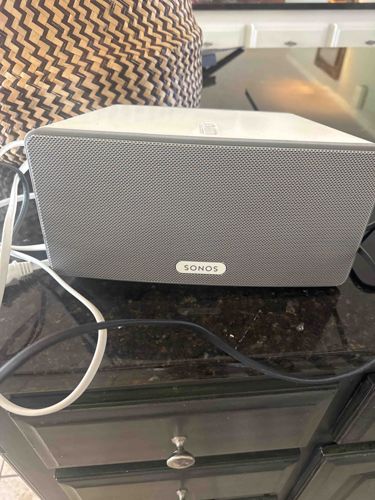
The item is identified as a Sonos PLAY:5 (Gen 1) wireless speaker, a tabletop or bookshelf audio device designed for multi-room music streaming. It features a rectangular, somewhat squat form factor with rounded edges. The primary color visible is a light grey for the speaker grille which covers the entire front face. The top and sides appear to be a slightly off-white or light beige color. The speaker grille is made of a perforated metal or a similar material with a fine, uniform mesh pattern, allowing sound to project while protecting the internal components. A notable feature is the 'SONOS' brand logo, prominently displayed in the center-bottom of the front grille on a small, recessed oval-shaped nameplate, which is also a light, creamy off-white color. The overall construction appears solid and well-built, characteristic of Sonos products. Visible condition issues include some dust accumulation on the top surface, suggesting regular use in a home environment. The speaker is shown sitting on a dark, possibly granite or quartz countertop, and several cables (white and black) are visible near its left side and rear, indicating its connectivity. The design aesthetic is minimalist and modern, typical of electronics from the 2010s. Based on the visible branding and design, it clearly belongs to the first generation of the Sonos PLAY:5 lineup, manufactured by Sonos Inc. The quality of craftsmanship is apparent in the seamless integration of the grille and casing, and the discreet placement of controls (not visible in this angle, typically on the top surface).
AI Appraisal Report
I have examined the provided image of the Sonos PLAY:5 (Gen 1) wireless speaker. This unit appears to be authentic, consistent with the design, branding, and build quality typical of Sonos products from that era. The prominent 'SONOS' logo on the front grille and the overall minimalist aesthetic align perfectly with the first generation PLAY:5 model.
Based on visual inspection alone, the condition appears to be good. There is visible dust accumulation on the top surface, which suggests regular use in a home environment but no obvious signs of significant damage like dents, deep scratches, or cracks. The grille appears intact, and the casing color slightly off-white, as expected for this model and its age.
In terms of market conditions, the Sonos PLAY:5 (Gen 1) is an older model. While Sonos products generally hold their value better than many electronics due to software support and brand loyalty, the release of subsequent generations (Gen 2 and the Era 300) has significantly impacted the resale value of the original PLAY:5. Demand for the Gen 1 is moderate, primarily from those seeking a more budget-friendly entry into the Sonos ecosystem or looking to expand an existing older system. Rarity is low; these were mass-produced.
Factors significantly impacting value are its age, the availability of newer, more capable models, and the lack of certain modern features (e.g., Apple AirPlay 2 support for Gen 1 without a BRIDGE or BOOST). The dust, while minor, indicates it\'s been in use and not pristine.
Limitations in authenticity verification are inherent when appraising from images alone. I can confirm the model visual characteristics match. However, I cannot verify internal component health, speaker driver integrity, port functionality, or network connectivity without a physical inspection. An in-person examination would allow for power-on testing, listening for audio distortion, checking all inputs/outputs, and verifying Wi-Fi/Ethernet connectivity. Provenance documentation (original purchase receipts) could further solidify its authenticity and history, though it's less critical for electronics of this type than for higher-value collectibles.