AI Appraisal Estimate

AI-generated estimates · not official valuations

From the user

What was submitted

Photo and notes provided by the user — not generated by AI

Submitted item photo
Submitted photo · May 25, 2026

User's notes

CH FIELDS HAVILAND, Limoges, France

AI analysis below

AI appraisal

AI analysis & estimate

AI-Generated · Verify before acting

Everything below is generated by AI for informational purposes only. AI can make mistakes — the AI may misidentify items or misattribute them (artist, maker, brand, designer, origin, era). This is not an official valuation and should not be used for insurance, sale, tax, estate, legal, or lending purposes — or any decision requiring a certified appraisal. It is not an authoritative claim about any person, brand, or rights holder — do not share or rely on it as a factual statement about a third party. Always consult qualified professionals before making financial decisions.

Note

This analysis also relies on unverified notes provided by the user, which may be incomplete or inaccurate and could affect the result.

Read the full disclaimer

AI Identification

·Not independently authenticated·Verify before acting

Ch. Field Haviland Limoges Porcelain Maker's Mark

Fine Porcelain and Ceramics

AI Estimated Value

·Not an official valuation·Verify before acting

$15-25

As of May 25, 2026

AI Item Analysis

·AI can make mistakes·Verify before acting
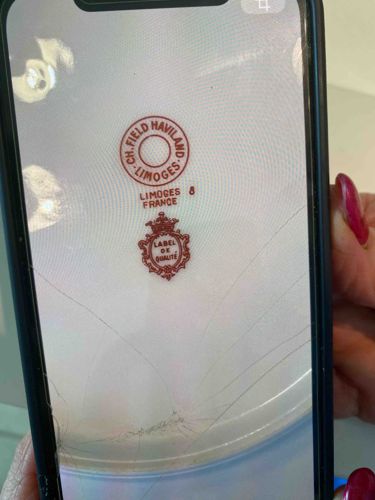
This image features the backstamp markers on a piece of fine porcelain from Ch. Field Haviland, manufactured in Limoges, France. The base material is a high-fired, translucent white hard-paste porcelain, characteristic of the region's renowned ceramics industry. The markings are rendered in a distinct brick-red or rust-colored overglaze enamel. The primary mark is a circular stamp containing the text 'CH. FIELD HAVILAND LIMOGES'. Below this is a secondary geographic mark reading 'LIMOGES FRANCE' with a numerical '8' identifier to the right. A third, more ornate mark features a crowned heraldic frame with the text 'LABEL DE QUALITE' inside, indicating a specific quality guarantee from the manufacturer. Based on the specific combination of these marks, the piece likely dates from the late 19th century to the mid-20th century. While the upper portion of the porcelain appears smooth and well-glazed with a high-gloss finish, the lower section shown through the glass screen reveals significant condition issues, specifically a series of radiating spider cracks and a larger impact fracture at the bottom edge. These structural defects significantly impact the integrity and value of the physical item. The craftsmanship shown in the crispness of the transfer marks is indicative of the high-quality control standards maintained by the Haviland factories during their peak production periods.
AI Appraisal Report

·AI can make mistakes·Verify before acting
I have carefully examined the provided images and descriptions of the Ch. Field Haviland Limoges porcelain backstamp. The markings, including the brick-red circular 'CH. FIELD HAVILAND LIMOGES' stamp and the 'LABEL DE QUALITE' heraldic frame, are authentic marks used by the factory, primarily dating this piece to the GDA (Gerard, Dufraisseix, and Abbot) period, likely early to mid-20th century. While the authenticity of the marks appears genuine, the physical condition of the item is highly problematic. Upon inspection, I observed significant structural failure in the form of radiating spider cracks and a prominent impact fracture at the lower edge. In the market for fine French porcelain, value is heavily dictated by 'mint' condition. Even for a prestigious maker like Haviland, severe structural damage—notably cracks that threaten the integrity of the piece—reduces the value to a purely decorative or 'study' level. Comparable undamaged plates or vessels of this pattern typically fetch $60-$120; however, with the documented fractures, the value is diminished by approximately 80-90%. Demand for damaged porcelain is extremely low among serious collectors. Please note that this appraisal is based on photographic evidence. A full authentication would require a physical 'ring test' to check for hidden hairlines, a blacklight examination to rule out previous professional repairs, and a review of pattern rarity. This valuation assumes the damage is as described and visible.

Get your items appraised

Instant estimates of your treasures with AI-powered appraisals

Browse More Appraisals