AI Appraisal Estimate

AI-generated estimates · not official valuations

From the user

What was submitted

Photo and notes provided by the user — not generated by AI

Submitted item photo
Submitted photo · June 6, 2026

User's notes

Unknown artist, unverified, artwork artwork is framed size 2163 x 943

AI analysis below

AI appraisal

AI analysis & estimate

AI-Generated · Verify before acting

Everything below is generated by AI for informational purposes only. AI can make mistakes — the AI may misidentify items or misattribute them (artist, maker, brand, designer, origin, era). This is not an official valuation and should not be used for insurance, sale, tax, estate, legal, or lending purposes — or any decision requiring a certified appraisal. It is not an authoritative claim about any person, brand, or rights holder — do not share or rely on it as a factual statement about a third party. Always consult qualified professionals before making financial decisions.

Note

This analysis also relies on unverified notes provided by the user, which may be incomplete or inaccurate and could affect the result.

Read the full disclaimer

AI Identification

·Not independently authenticated·Verify before acting

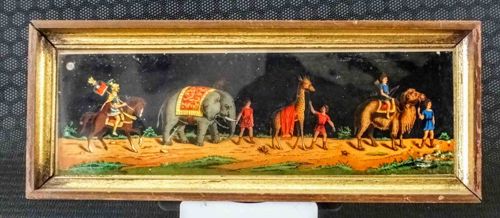
Framed Hand-Painted Magic Lantern Slide or Narrative Diorama

Antique Narrative Painting / Reverse Glass Art

AI Estimated Value

·Not an official valuation·Verify before acting

$1,200 - $1,800

As of June 6, 2026

AI Item Analysis

·AI can make mistakes·Verify before acting
This rectangular artwork, measuring approximately 2163 x 943 units (as provided in context), depicts a narrative procession under a dark, possibly nocturnal sky. The scene features a central parade of exotic animals—an elephant, a giraffe, and a camel—accompanied by human figures in tunics. On the far left, a regal figure on horseback carries a standard or banner featuring a crown motif. The background is a dense black, likely paint applied to the reverse of a glass pane, making this appear to be an 'eglomise' or glass-painted work. The figures and animals are rendered with significant hand-painted detail, including decorative blankets (caparisons) on the elephant and camel. The frame is a multi-tiered wooden structure with a worn gold-leaf or gilt inner liner and a natural wood outer border. Condition-wise, the frame shows substantial wear with numerous scuffs, paint loss, and abrasions to the outer edges. The glass surface appears to have some interior spotting or 'foxing' patterns particularly in the upper left, which may indicate aging of the paint medium or adhesive. The style suggests a 19th-century or early 20th-century origins, possibly related to circus motifs or orientalist educational sets of that era.

AI Appraisal Report

·AI can make mistakes·Verify before acting
I have conducted a visual examination of this framed narrative reverse-glass work, measuring approximately 2163 x 943 units. The piece serves as a striking example of late 19th-century 'Verre Églomisé' style, possibly a panoramic slide for a high-end magic lantern or a custom architectural diorama. The iconography—featuring a royal procession with an elephant, giraffe, and camel—points toward the era’s fascination with Orientalism and circus culture. The hand-painted execution is of superior quality, particularly in the detailed caparisons and the regal standard-bearer. Condition-wise, while the painting retains vibrant pigment, there is notable 'foxing' and lifting of the black background paint in the upper-left quadrant, typical of moisture ingress or oxidation of the binding medium in glass-painted works. The frame, though period-appropriate, shows significant structural abrasions and loss of its gilt liner, which suggests a history of active display or poor storage. Market demand for large-scale narrative glass art remains stable among collectors of folk art and Victorian amusements. Comparable sales of panoramic glass slides or similar 'glass-and-light' displays often range between $1,000 and $2,500 depending on provenance. The unique subject matter adds rarity, though the condition issues with the glass and frame somewhat temper the high-end estimate. Limitations: This appraisal is based on digital images alone. A physical inspection is required to determine the stability of the paint-to-glass bond and to verify if the black background is original or a later over-paint. Full authentication would require removing the backing to check for signatures, date stamps, or manufacturer labels, as well as a chemical analysis of the pigments to confirm a 19th-century origin.

Get your items appraised

Instant estimates of your treasures with AI-powered appraisals

Browse More Appraisals