AI Appraisal Estimate

AI-generated estimates · not official valuations

From the user

What was submitted

Photo and notes provided by the user — not generated by AI

Submitted item photo
Submitted photo · June 1, 2026

User's notes

No additional notes provided.

AI analysis below

AI appraisal

AI analysis & estimate

AI-Generated · Verify before acting

Everything below is generated by AI for informational purposes only. AI can make mistakes — the AI may misidentify items or misattribute them (artist, maker, brand, designer, origin, era). This is not an official valuation and should not be used for insurance, sale, tax, estate, legal, or lending purposes — or any decision requiring a certified appraisal. It is not an authoritative claim about any person, brand, or rights holder — do not share or rely on it as a factual statement about a third party. Always consult qualified professionals before making financial decisions.

Read the full disclaimer

AI Identification

·Not independently authenticated·Verify before acting

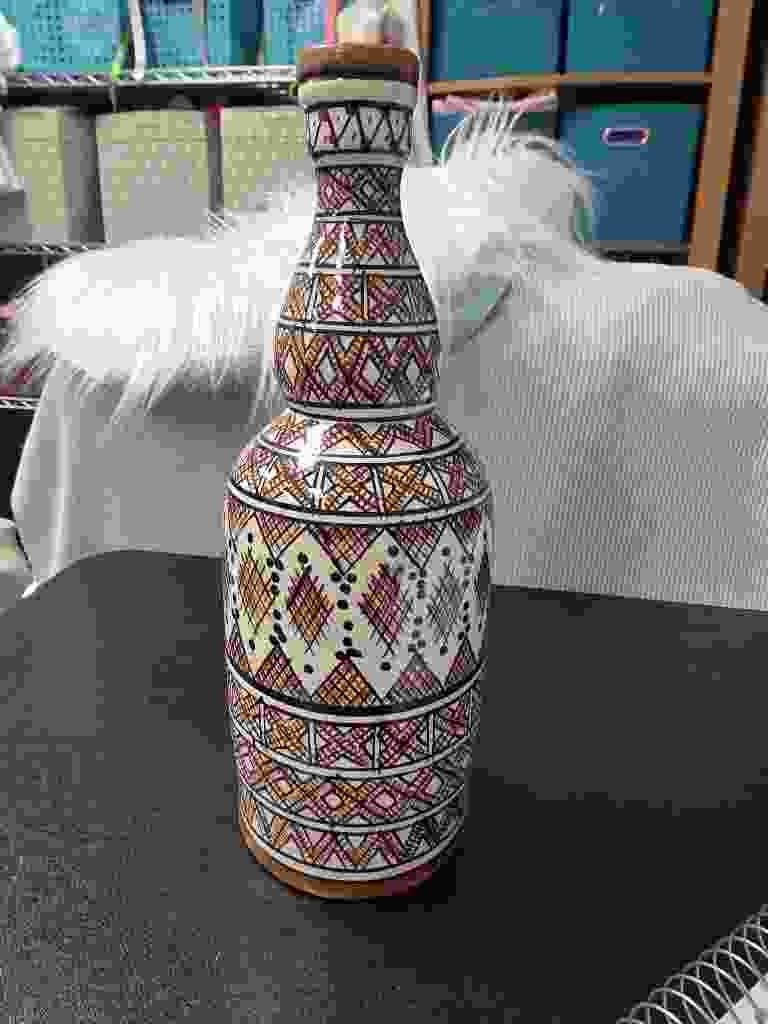
Vintage Moroccan Safi Pottery Decanter

Cultural Ceramics and Pottery

AI Estimated Value

·Not an official valuation·Verify before acting

$125 - $185

As of June 1, 2026

AI Item Analysis

·AI can make mistakes·Verify before acting
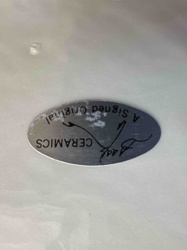
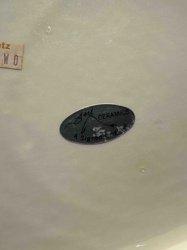
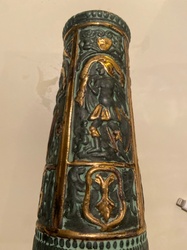
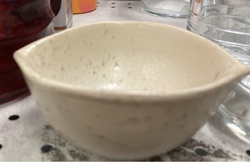
This item is a handcrafted Moroccan ceramic bottle or decanter, famously produced in the coastal city of Safi. The vessel features a traditional double-bulbous silhouette consisting of a cylindrical lower body and a segmented neck, culminating in a fitted stopper with a wooden or cork top. It is constructed from kiln-fired clay and finished with a white tin glaze that serves as a canvas for intricate hand-painted geometric patterns. The decoration is executed in a polychrome palette dominated by ochre, earthy red, and black slip, utilizing traditional Moroccan motifs such as diamonds, chevrons, and hatched cross-hatching. The craftsmanship is indicative of Mid-20th-century folk art, characterized by slightly irregular line work that confirms its handmade nature. Physically, the glaze shows a high-gloss finish typical of lead-based or modern food-safe glazes. Condition-wise, the item appears well-preserved with no visible large chips or cracks, though fine crazing (minute surface cracks in the glaze) is likely present upon close inspection due to age and thermal expansion. There are minor inconsistencies in the paint application and firing, which are standard for artisanal pottery of this region. This style of 'Safi Ware' is highly collectible for its vibrant Berber-inspired aesthetics and historical significance in North African ceramic traditions.
AI Appraisal Report

·AI can make mistakes·Verify before acting
After examining the digital documentation of this Safi pottery decanter, I find it to be a representative example of Mid-20th-century Moroccan folk art. The double-bulbous form and polychrome slip decoration—utilizing the traditional ochre-red and black palette over a tin glaze—align with established motifs from the Safi region. The presence of slight irregularities in the hatching and line work are positive indicators of hand-painted authenticity rather than mass-produced transfers. The condition appears Excellent for its age; the gloss finish remains vibrant, and the fitted stopper is a valuable inclusion, as these are frequently lost over time. The market for Safi 'Safi Ware' remains steady among collectors of North African ceramics and Mid-Century global decor. Comparable sales for similar polychrome decanters of this size and era typically fall within the $100 to $200 range. Its value is supported by its aesthetic 'bohemian' appeal, though it is not considered a high-rarity museum piece. Limitation Disclosure: This appraisal is based solely on visual analysis of digital images. I cannot definitively verify the absence of structural repairs hidden by glaze, nor can I evaluate the specific glaze composition (e.g., lead content) which affects utility value. A physical inspection is required to check for 'thud' vs. 'ring' resonance (indicating internal cracks) and to verify tactile glaze age. To fully authenticate this as a vintage piece rather than a modern reproduction, provenance documentation such as a bill of sale or photographic evidence of it in a collection pre-1970 would be necessary. Scientific testing (thermoluminescence) is not economically justified for this price point but would be the only way to establish a definitive firing date.

Get your items appraised

Instant estimates of your treasures with AI-powered appraisals

Browse More Appraisals