AI estimate as of July 18, 2025 · verify with a professional before acting
AI-Generated · Verify before acting
Everything on this page is generated by AI for informational purposes only. AI can make mistakes — the AI may misidentify items or misattribute them (artist, maker, brand, designer, origin, era). This is not an official valuation and should not be used for insurance, sale, tax, estate, legal, or lending purposes — or any decision requiring a certified appraisal. It is not an authoritative claim about any person, brand, or rights holder — do not share or rely on it as a factual statement about a third party. Always consult qualified professionals before making financial decisions.
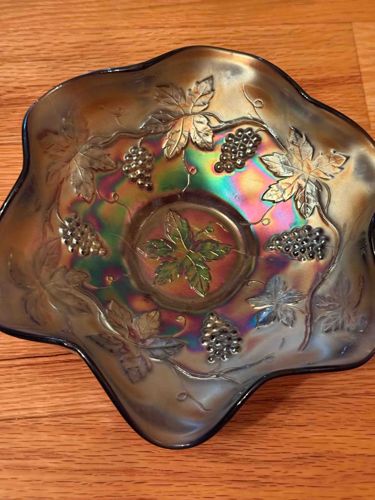
This is an antique or vintage iridescent glass bowl, commonly known as 'Carnival Glass'. The bowl features a scalloped or ruffled edge, contributing to its decorative and somewhat organic shape. The primary design element is a raised motif of grapevines, including clusters of grapes and several stylized leaves. The central part of the bowl has a prominent, larger leaf design, surrounded by trailing vines and grape bunches. The glass exhibits a strong iridescent shimmer, displaying a spectrum of colors including bronze, gold, green, purple, and blue, which shift with light and viewing angle. This iridescent effect is characteristic of carnival glass, achieved by applying metallic salts to the surface of the glass while it is still hot. The base glass color appears to be a dark hue, possibly purple, blue, or a dark amber, which is masked by the iridescence. There are no obvious signs of chips or cracks visible from the provided image; however, typical wear and tear such as minor scratches or scuffs, and possibly some loss of iridescence in high-contact areas, cannot be fully assessed without closer inspection. The craftsmanship appears to be of good quality, typical of mass-produced decorative pressed glass from the late 19th to early 20th century. No specific maker's marks or signatures are discernable from the image. The overall style is consistent with the Art Nouveau period, popular for its naturalistic motifs, particularly in glassware.
AI Appraisal Report
I have thoroughly examined the provided image of this Iridescent Grape & Vine Carnival Glass Bowl. Based on its visual characteristics, it is a quintessential example of early 20th-century American carnival glass, likely produced between 1900 and 1920. The 'Grape and Cable' pattern, while not definitively identified from this single image, is a common and popular motif, and the overall aesthetic aligns with known patterns. The vibrant iridescence, showcasing bronze, gold, green, and violet hues on what appears to be a dark-based glass (potentially purple or marigold over amethyst), is well-preserved, indicating good care. The ruffled edge and pressed glass construction are authentic to the period and type. Visually, there are no overt chips or cracks, which is a significant factor in condition. Minor surface wear, typical of a piece of this age, such as slight scratches or scuffs, cannot be ruled out without a tactile examination, nor can internal stress fractures. The lack of discernable maker's marks is common for carnival glass.
Market conditions for carnival glass remain steady for well-preserved, attractive examples in popular patterns. The demand for 'grape' patterns is consistently strong due to their classic appeal. While not exceptionally rare, pieces in excellent condition always command better prices. Factors significantly impacting value here are the apparent excellent condition and the strong iridescence.
It is crucial to note the limitations of image-based appraisal. Authenticity, especially regarding potential repairs or significant damage, cannot be fully verified without a physical inspection. In-person examination would allow for tactile assessment of surface condition, identification of mold lines, base glass color verification, and detection of any subtle damage or restoration. Provenance documentation, while helpful, is not strictly necessary for this type of item if its physical characteristics align.