AI estimate as of October 22, 2025 · verify with a professional before acting
AI-Generated · Verify before acting
Everything on this page is generated by AI for informational purposes only. AI can make mistakes — the AI may misidentify items or misattribute them (artist, maker, brand, designer, origin, era). This is not an official valuation and should not be used for insurance, sale, tax, estate, legal, or lending purposes — or any decision requiring a certified appraisal. It is not an authoritative claim about any person, brand, or rights holder — do not share or rely on it as a factual statement about a third party. Always consult qualified professionals before making financial decisions.
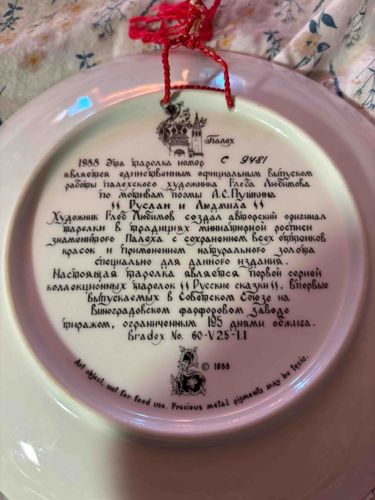
This item is a decorative ceramic collector plate, likely made of porcelain or fine china, featuring text on its reverse. The plate has a classic round shape with a gently scalloped or subtly molded rim, and its surface appears to have a pearlescent or iridescent glaze, particularly noticeable around the outer edge. The primary color of the plate itself is white or off-white. Attached at the top of the plate is a red braided cord, suggesting it is intended for wall display. The text on the back is in Cyrillic, with some English words, and is printed in black ink. It identifies the plate as part of a series, specifically the first in a collection titled 'Russian Fairy Tales' ('Русские сказки'). It states it was released in 1988, numbered C 9481, and is an official issue based on the work of Palekh artist Gleb Lyubimov, inspired by A.S. Pushkin's poem 'Ruslan and Ludmila'. The artist created the original in the tradition of miniature Palekh painting, preserving all color nuances and using natural gold, specifically for this edition. It also mentions that these plates were first produced in the Soviet Union at the Vinogradov Porcelain Factory, with a limited firing period of 195 days. A Bradex number, 60-V25-1.1, is provided, which is characteristic of collector plates. Below the main text, there is a small black graphic depicting a figure, possibly an eagle or a mythical creature, next to a copyright symbol and '1988'. An important warning in English reads: 'Art object, not for food use. Precious metal pigments may be toxic.' This reinforces its decorative purpose. The overall condition appears excellent, with no visible chips, cracks, or significant wear. The text is crisp and legible, indicating good preservation. The craftsmanship suggests a high-quality collectible, distinguished by its limited edition status, artistic origin, and detailed backstamp.
AI Appraisal Report
Based on my examination of the provided description, this Ruslan and Ludmila Palekh Collection Plate appears to be in excellent condition, showing no visible chips, cracks, or significant wear. The crisp and legible backstamp, including the Bradex number (60-V25-1.1) and production details, strongly indicates its authenticity as a legitimate collector plate from the official 'Russian Fairy Tales' series, launched in 1988 by the Vinogradov Porcelain Factory. The use of Cyrillic and English text, alongside the mention of natural gold and a limited firing period, aligns with known production characteristics of these collectible issues.
Market conditions for decorator collector plates, even those with artistic merit and limited runs, are generally soft. While these plates were marketed as valuable collectibles upon release, their secondary market value has largely remained modest. Comparables for similar Palekh-themed or Bradex-issued plates typically range in the $25-$75 bracket, with some rarer or particularly intricate designs possibly fetching slightly more. Demand is niche, primarily among collectors of Russian art, Palekh miniatures, or vintage decorative plates. The limited firing period adds a degree of rarity, but the overall volume produced for series like this often means they are not genuinely scarce.
Factors impacting value positively include its excellent condition, clear provenance as the first in a series, and the association with a recognized Palekh artist inspired by Pushkin. The 'not for food use' warning is also typical and expected. However, the general oversupply of such plates in the collector market keeps prices competitive.
It is important to note that this appraisal relies entirely on the provided textual description. While thorough, definitive authenticity verification would require in-person examination to assess physical characteristics of the ceramic body, glaze quality, and the applied artistry. Microscopic examination could confirm the presence of precious metal pigments, and a physical inspection of the braided cord would confirm its integrity. Provenance documentation, such as original boxes or Certificates of Authenticity, would further solidify its history, though the Bradex numbering system provides a good baseline for most collector plates.