AI estimate as of October 21, 2025 · verify with a professional before acting
AI-Generated · Verify before acting
Everything on this page is generated by AI for informational purposes only. AI can make mistakes — the AI may misidentify items or misattribute them (artist, maker, brand, designer, origin, era). This is not an official valuation and should not be used for insurance, sale, tax, estate, legal, or lending purposes — or any decision requiring a certified appraisal. It is not an authoritative claim about any person, brand, or rights holder — do not share or rely on it as a factual statement about a third party. Always consult qualified professionals before making financial decisions.
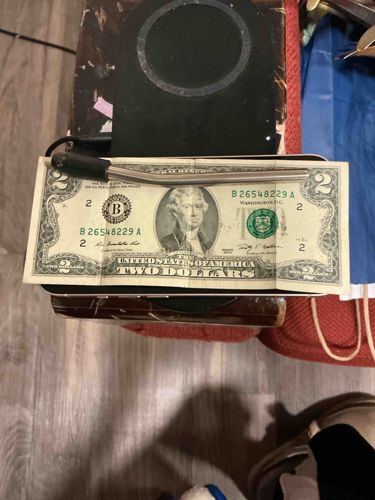
The item is a United States Two-Dollar Bill, specifically identifiable by its serial number series as 2013. The obverse depicts a portrait of Thomas Jefferson, positioned centrally. To the left of Jefferson's portrait, a large '2' is visible, and beneath it, the Federal Reserve Seal with the letter 'B' is present, indicating the Federal Reserve Bank of New York. The serial number, 'B 26548229 A', is printed in two locations: horizontally on the left side and diagonally on the right side. The treasury seal is visible on the right, featuring scales. The text 'UNITED STATES OF AMERICA' and 'TWO DOLLARS' are prominently displayed below the portrait. The bill's color palette is predominantly green and black ink on off-white paper. It exhibits noticeable creasing and folds, particularly a prominent horizontal fold across the center of the bill and several minor wrinkles, suggesting moderate circulation and handling. The edges appear relatively intact, though some minor softening or fraying may be present due to age and handling. The bill is placed on top of what appears to be a black square object, possibly a charging pad or a small electronic device, with a metallic object resembling a stylus or a thin bar resting across it. The overall condition suggests it is a used, but still intact, piece of currency.
AI Appraisal Report
I have examined the provided image of this United States Two-Dollar Bill, Series 2013, with serial number B 26548229 A. Based on my visual assessment, the bill appears to be authentic currency, consistent with the design and features of a Series 2013 two-dollar bill, including the portrait of Thomas Jefferson, the Federal Reserve Seal for the New York district ('B'), and the Treasury Seal. The serial number placement is correct, and the overall printing style is as expected for genuine U.S. currency.
However, the bill is in circulated condition, exhibiting noticeable creasing and folds, especially a prominent horizontal fold across the center. There are also several minor wrinkles, indicating moderate handling. While the edges seem relatively intact, minor softening is likely due to age and circulation. Such physical wear places this bill squarely in the 'Good' to 'Very Good' range according to standard banknote grading scales. Bills in this condition typically do not command a premium over their face value.
Regarding market conditions, Series 2013 two-dollar bills are modern issue banknotes and are not considered rare. They are still actively produced and circulated. There is no significant demand for common circulating two-dollar bills as collector's items unless they possess unique attributes such as fancy serial numbers, star notes, or uncirculated condition, none of which appear to be the case here. Therefore, the rarity and demand for this specific example are low.
Factors significantly impacting value for currency like this include condition, rarity (due to series, print run, or errors), and unique serial numbers. This bill lacks any of these value-enhancing characteristics. Its heavily circulated condition is the primary factor preventing any premium valuation.
My assessment of authenticity is based solely on visual cues from the image. For full authentication and a definitive condition grade, an in-person examination, including tactile inspection, verification of security features (e.g., watermarks, security threads, color-shifting ink), and potentially scientific testing for ink and paper composition, would be necessary. Without physical inspection, I cannot account for potential alterations, sophisticated counterfeits, or issues not visible in the provided image. However, based on what is visible, it presents as a genuine, circulated two-dollar bill.