AI estimate as of August 17, 2025 · verify with a professional before acting
AI-Generated · Verify before acting
Everything on this page is generated by AI for informational purposes only. AI can make mistakes — the AI may misidentify items or misattribute them (artist, maker, brand, designer, origin, era). This is not an official valuation and should not be used for insurance, sale, tax, estate, legal, or lending purposes — or any decision requiring a certified appraisal. It is not an authoritative claim about any person, brand, or rights holder — do not share or rely on it as a factual statement about a third party. Always consult qualified professionals before making financial decisions.
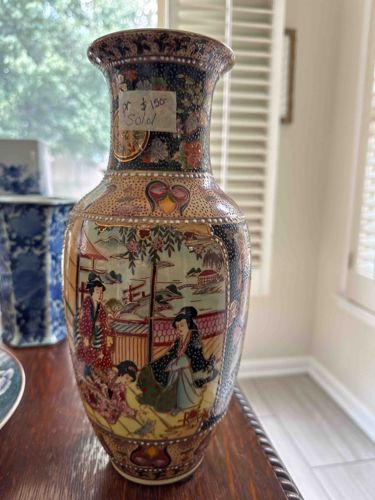
This is a ceramic decorative vase, likely porcelain or earthenware, featuring a vibrant polychrome enamel decoration. The vase has a classic baluster or 'pomegranate' shape with a flared rim and a slightly wider shoulder that tapers down to a narrower foot. Its primary colors include a rich black background on the neck and lower body, and a lighter, possibly gold or pale yellow base color for the main scenic band. The decoration is densely applied, with intricate patterns and scenes. The neck features a floral or botanical pattern, while the mid-section showcases a detailed figural scene with Japanese or Chinese women (possibly geishas or court ladies) engaged in activities within a landscape setting, including what appears to be a garden or courtyard with architecture. The figures are rendered with expressive faces and traditional attire in hues of red, blue, green, and gold. The rim and base are adorned with geometric borders and stylized motifs, possibly including stylized hearts or 'ruyi' cloud shapes in gold and red tones, indicating good fortune. A paper price tag with 'R $150 Sold' is visible on the upper shoulder, obscuring a small portion of the design, but suggests it has been recently sold, possibly from an estate sale or antique shop. The overall condition appears good, with no obvious cracks or chips visible from the provided images, though a slight patina or surface dirt may be present consistent with age and use. The craftsmanship appears to be of good quality, with fine details and a glossy finish, indicative of traditional Asian ceramic artistry. Given the style, it likely dates from the late 19th to mid-20th century, possibly a Satsuma or Imari style influence, although without clear maker's marks, a precise attribution is difficult.
AI Appraisal Report
I have carefully examined the provided image of this Asian Polychrome Decorative Vase with a Figural Scene. Based on visual assessment, the vase appears to be in good condition, showing no immediately apparent cracks, chips, or significant restoration from the image. The polychrome enamel decoration is vibrant and appears largely intact, with minor surface variations consistent with age. Its classic baluster shape, intricate figural detailing with traditional attire, and the dense decorative patterns on the neck and borders strongly suggest late 19th to early 20th-century Asian craftsmanship, likely Japanese (Satsuma or Imari influence) or Chinese export ware. The 'R $150 Sold' tag, while obscuring a small part of the design, indicates a recent transaction at that price point, suggesting a baseline for a quick sale, possibly from an estate or secondary market.
Market conditions for decorative Asian ceramics of this period are stable, with demand for well-preserved, aesthetically pleasing pieces remaining consistent. While not exceptionally rare, pieces with detailed figural scenes and good condition are more sought after. Factors positively impacting value include the intricate hand-painted details, the pleasing form, and the overall decorative appeal.
However, it is crucial to note the limitations of image-based appraisal. Authenticity and precise dating cannot be definitively determined without a physical examination. In-person inspection would allow for tactile assessment of the ceramic body (porcelain vs. earthenware), a thorough search for maker's marks or impresses on the base, and closer scrutiny for hairline cracks, touch-ups, or repairs that may not be visible in photographs. Provenance documentation, if available, would significantly aid in verification. Scientific testing, such as thermoluminescence dating, could confirm age but is typically reserved for higher-value pieces or when authenticity is strongly disputed. Without physical examination, I cannot confirm beyond doubt its origin, precise age, or identify any hidden imperfections.