AI estimate as of August 8, 2025 · verify with a professional before acting
AI-Generated · Verify before acting
Everything on this page is generated by AI for informational purposes only. AI can make mistakes — the AI may misidentify items or misattribute them (artist, maker, brand, designer, origin, era). This is not an official valuation and should not be used for insurance, sale, tax, estate, legal, or lending purposes — or any decision requiring a certified appraisal. It is not an authoritative claim about any person, brand, or rights holder — do not share or rely on it as a factual statement about a third party. Always consult qualified professionals before making financial decisions.
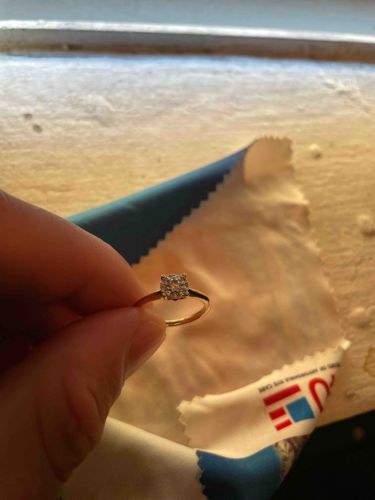
The item is a ladies' ring, likely an engagement or anniversary ring, featuring a cluster diamond setting on a yellow gold band. The ring is held between a thumb and forefinger, with a light-colored, possibly white or cream-colored, polishing cloth with a red and blue logo visible underneath. The band appears to be made of polished yellow gold, exhibiting a smooth, lustrous surface. The central setting comprises multiple small, round brilliant cut diamonds, closely set together to create the illusion of a larger, square-shaped diamond. This 'cluster' style maximizes sparkle and visual impact while potentially utilizing smaller, more affordable stones. The craftsmanship appears to be standard, with the stones securely set. There are no obvious signs of significant wear, damage, or repairs visible in the image, suggesting good to very good overall condition. The yellow gold shows some expected reflections, but no major scratches or tarnishing are discernible. The style period is difficult to ascertain precisely without additional context or markings, but cluster settings have been popular across several decades, from the mid-20th century to contemporary designs. No manufacturer's marks or signatures are visible in the provided image.
AI Appraisal Report
Upon examining the provided image of this yellow gold diamond cluster ring, I assess its condition to be good to very good. The yellow gold band appears polished and free from significant scratches or tarnishing. The cluster setting, designed to mimic a larger square diamond, utilizes multiple small round brilliant cut diamonds, which are securely set. There are no visible signs of damage, wear consistent with heavy use, or repairs.
Authenticity: Based solely on the image, the ring appears to be a genuine piece of jewelry, with what seem to be natural diamonds. However, visual examination alone limits definitive authentication of the diamonds' origin (natural vs. synthetic) and specific characteristics (e.g., clarity, color grades), and the gold's purity. For full authentication, in-person examination by a gemologist is crucial. This would involve inspecting the stones under magnification, assessing cut quality, and potentially conducting tests such as thermal conductivity or spectrographic analysis. Additionally, verifying the gold content would require specific testing like XRF or assay.
Market Conditions and Comparables: Cluster settings are perennially popular due to their ability to provide significant sparkle and visual presence at a more accessible price point compared to single large solitaire diamonds. The market for such pre-owned diamond jewelry is generally stable, driven by aesthetic appeal and inherent material value. Comparable items in the secondary market, especially online or at estate jewelers, often range depending on the total carat weight and quality of the diamonds, as well as the gold content and overall craftsmanship.
Demand and Rarity: This style of ring is a common and desirable design, making it less rare than high-end designer pieces or antique items with unique historical significance. Its broad appeal ensures consistent demand.
Factors Impacting Value: Key factors influencing this ring's value include the total carat weight of the diamonds, their collective quality (color, clarity), the purity of the yellow gold (e.g., 10k, 14k, 18k), and the overall craftsmanship. Without knowing these precise specifications, particularly the total diamond weight and quality, the appraisal is an estimate. Should the diamonds be of higher quality or the gold be 18k, the value would lean towards the higher end of the range. Conversely, lower quality diamonds or 10k gold would place it at the lower end.
Limitations: My appraisal is strictly limited by the visual information in the image. I cannot confirm the exact carat weight, clarity, color, or origin of the diamonds, nor the precise purity of the gold alloy. These details are critical for a precise valuation and require physical examination and gemological testing. Provenance documentation, if available, would also add value.