AI estimate as of October 4, 2025 · verify with a professional before acting
AI-Generated · Verify before acting
Everything on this page is generated by AI for informational purposes only. AI can make mistakes — the AI may misidentify items or misattribute them (artist, maker, brand, designer, origin, era). This is not an official valuation and should not be used for insurance, sale, tax, estate, legal, or lending purposes — or any decision requiring a certified appraisal. It is not an authoritative claim about any person, brand, or rights holder — do not share or rely on it as a factual statement about a third party. Always consult qualified professionals before making financial decisions.
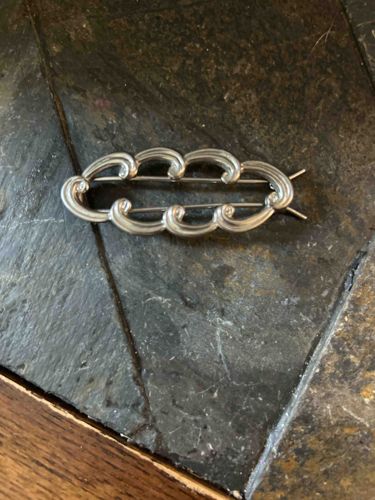
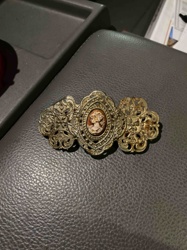
This item is an oval-shaped barrette, likely crafted from a silver-toned metal, possibly sterling silver, silver plate, or a polished base metal. Its design features a double row of intertwined, undulating scroll or "C" shapes, forming an openwork, symmetrical pattern. The surface appears polished and reflective, indicating a smooth finish with some light surface wear consistent with age and use, though no significant damage like deep scratches or dents are immediately visible. The craftsmanship suggests a cast or stamped construction, with the scroll elements appearing fluid and well-defined. The design evokes an Art Nouveau aesthetic, characterized by its organic, flowing lines. On the reverse side, two hairpins extend from one end, designed to secure the barrette in place, suggesting it is a functional hair accessory. One of the pins appears to be slightly bent or angled, but the overall structure seems intact. There are no discernible maker's marks or stamps visible in the provided image, which would be crucial for determining the manufacturer, material composition, and precise age. Given its stylistic elements, it could date from the late 19th century to the mid-20th century, or be a more modern reproduction inspired by Art Nouveau. The quality of the metal work, while not high-end fine jewelry, appears to be well-executed for a decorative hair accessory, with clean lines and uniform curves.
AI Appraisal Report
I have examined the provided image of this Art Nouveau Style Silver-Tone Barrette. Visually, the piece presents with an attractive openwork design featuring intertwined, undulating scroll or 'C' shapes, characteristic of the Art Nouveau aesthetic. The surface appears polished and reflective, indicating a silver-toned metal, though without physical inspection, I cannot confirm if it is sterling silver, silver plate, or a polished base metal. There is some light surface wear consistent with age and use, but no significant damage is immediately apparent. The craftsmanship suggests a well-executed cast or stamped construction for a decorative hair accessory.
Authenticity: Based solely on the image, the design is indeed Art Nouveau in style. However, without maker's marks or an in-person examination, it is impossible to definitively authenticate its age or material composition. It could be an original piece from the late 19th to mid-20th century or a later reproduction.
Market Conditions and Comparables: Similar unmarked Art Nouveau-style barrettes made of silver-toned base metals or silver plate typically sell in the $30-$70 range. If it were confirmed to be sterling silver, the value would increase, potentially to $75-$150, depending on weight and confirmed age. Demand for decorative hair accessories and Art Nouveau style items remains consistent among collectors and enthusiasts, but rarity for unmarked pieces of uncertain material is generally low.
Factors Impacting Value: The primary factors impacting value are the unknown material composition and the lack of maker's marks. The slightly bent hairpin on the reverse is a minor condition issue but does not significantly detract from the overall aesthetic. For full authentication and to determine the precise material and age, a physical inspection by a qualified gemologist or metalsmith, possibly including XRF testing, would be required. Provenance documentation, if available, would also be invaluable. Without these, the appraisal value remains conservative.