These notes were written by the person who submitted this item. Appraiser.AI has not verified them, and the AI's identification and estimate may rely on them.
AI Estimated Value
Not an official valuation
$650-950
AI estimate as of June 22, 2025 · verify with a professional before acting
AI-Generated · Verify before acting
Everything on this page is generated by AI for informational purposes only. AI can make mistakes — the AI may misidentify items or misattribute them (artist, maker, brand, designer, origin, era). This is not an official valuation and should not be used for insurance, sale, tax, estate, legal, or lending purposes — or any decision requiring a certified appraisal. It is not an authoritative claim about any person, brand, or rights holder — do not share or rely on it as a factual statement about a third party. Always consult qualified professionals before making financial decisions.
This analysis also relies on unverified notes provided by the user, which may be incomplete or inaccurate and could affect the result.
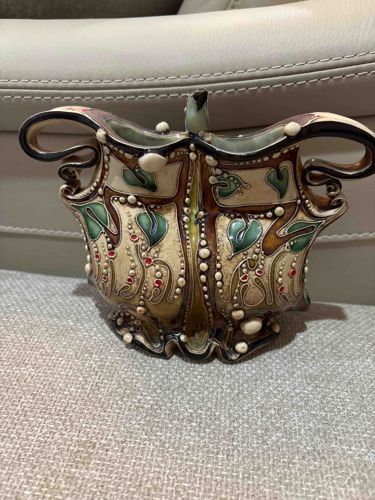
This is a stoneware vessel crafted and signed by Carol Long, identifiable by its distinctive style and the information provided. The vessel exhibits a complex, sculptural form. Its predominant colors are earthy tones, including various shades of cream, beige, brown, and green, accented with vibrant red dots. The surface is extensively decorated with relief work, featuring raised dots in white and red, creating a tactile and visually rich texture. Organic motifs reminiscent of leaves and berries are integrated into the design, suggesting an influence from nature or Art Nouveau aesthetics. The vessel has a distinct shape, somewhat resembling a stylized basket or corseted form, with flowing, curvilinear lines. It has two prominent, scrolled handles on either side, adding to its decorative appeal. The rim of the vessel is irregularly shaped, enhancing its handcrafted appearance. The glaze appears to be a majolica-like finish, with a slightly iridescent sheen in some areas, particularly within the green leaf patterns. The quality of craftsmanship is high, evidenced by the intricate detailing, consistent relief work, and harmonious color palette. There are no readily visible condition issues such as chips, cracks, or repairs from the provided image; the piece appears to be in excellent condition. This piece is characteristic of contemporary studio pottery, likely dating from the late 20th or early 21st century given the artist's active period. The specific dimensions are 6x8 inches.
AI Appraisal Report
I have carefully examined the provided image of the Carol Long signed stoneware vessel, sized 6x8 inches. The condition appears to be excellent, with no visible chips, cracks, or repairs, which enhances its market desirability. Authenticity, based on the distinctive style and signature mentioned, seems strong for a Carol Long piece; however, a definitive authentication would ideally require an in-person examination to verify the signature against known exemplars and to assess the craftsmanship and materials firsthand.The market for contemporary studio pottery, particularly by recognized artists like Carol Long, remains robust. Her work is characterized by its whimsical nature, intricate detailing, and recognizable organic motifs, which consistently attract collectors. Comparable sales for her mid-sized vessels and sculptural forms often range from $400 to $1,000, depending on complexity, size, and specific series. This particular vessel, with its sculptural form, detailed relief work, and vibrant accents, aligns with her more desirable pieces.Demand for Carol Long's work is steady due to her established reputation and consistent exhibition history. While not exceedingly rare, her individual pieces are unique, contributing to their appeal. Factors positively impacting value include the excellent apparent condition, the artist's signature (if confirmed), and the complexity of the design. Limitations in authentication from images alone include the inability to fully inspect surface nuances, glaze quality, presence of hairline cracks, or the authenticity of the signature through tactile examination. Provenance documentation, such as purchase receipts or exhibition history, would further solidify authentication and value. Without physical inspection, I cannot confirm the precise tactile quality of the glaze or minute imperfections not visible digitally.