AI estimate as of November 6, 2025 · verify with a professional before acting
AI-Generated · Verify before acting
Everything on this page is generated by AI for informational purposes only. AI can make mistakes — the AI may misidentify items or misattribute them (artist, maker, brand, designer, origin, era). This is not an official valuation and should not be used for insurance, sale, tax, estate, legal, or lending purposes — or any decision requiring a certified appraisal. It is not an authoritative claim about any person, brand, or rights holder — do not share or rely on it as a factual statement about a third party. Always consult qualified professionals before making financial decisions.
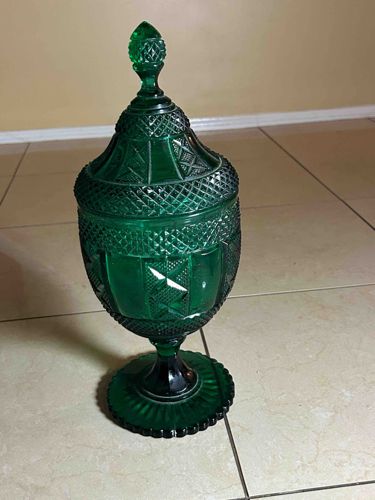
This item is an emerald green glass compote, complete with a fitted lid, showcasing intricate 'cut to clear' patterns. The compote structure consists of a bowl-like body resting on a flared pedestal and a round, scalloped base. The dominant color is a rich, translucent emerald green, suggesting it might be uranium glass, though a blacklight test would be needed to confirm this. The 'cut to clear' technique is evident throughout the piece, where portions of the green glass have been carved away, revealing a clear or frosted layer beneath, creating high contrast and visual depth. The decorative patterns include a series of diamond-cut motifs, hobnail-like textures, and geometric crosshatching, particularly prominent on the lid and the upper body of the compote. The finial on the lid is also elaborately cut, mimicking a faceted gemstone or stylized pinecone, with a diamond pattern. The craftsmanship appears to be of good quality, typical of pressed or cut glass pieces from the late 19th to mid-20th century, a period when such ornate glassware was highly popular. There are no immediately visible chips, cracks, or repairs detected from the image; however, closer inspection would be required to ascertain its pristine condition. The surface appears to be clean and free of significant scratches or wear, maintaining its original luster. The overall design suggests an item intended for decorative display or for serving confections.
AI Appraisal Report
Upon visual examination of the provided image, I find this emerald green 'cut to clear' glass compote with its fitted lid to be a very attractive piece of decorative glassware. The 'cut to clear' technique is well-executed, creating a high contrast and visual depth through diamond-cut motifs, hobnail-like textures, and geometric crosshatching. The craftsmanship appears to be of good quality, consistent with pressed or cut glass from the late 19th to mid-20th century. Based solely on the image, the condition appears excellent, with no immediately visible chips, cracks, or repairs, and the surface seems clean and lustrous. However, I must emphasize that this assessment is limited to what is visible in the photograph; an in-person, detailed inspection for hairline cracks, flea bites, or internal imperfections not apparent in a single image would be crucial to confirm its pristine condition.
In terms of market conditions, similar 'cut to clear' glass compotes, especially in vibrant colors like emerald green, generally see a fair demand. While not exceedingly rare, pieces in excellent condition with intricate patterns are sought after by collectors of antique and vintage glassware. Comparables in similar quality and condition typically fall within the $150-$250 range in the current market, factoring in the decorative appeal and perceived good state. The suggestion of this being uranium glass is interesting and, if confirmed by a blacklight test, could slightly enhance its value due to collector interest in glowing glass, perhaps pushing it to the higher end of the range. Provenance documentation, though unlikely for such an item, could also add to its historical value. Without physical inspection, the authenticity of the 'cut to clear' process versus a molded pattern cannot be 100% verified, though the crispness of the cuts suggests genuine cutting rather than molding.