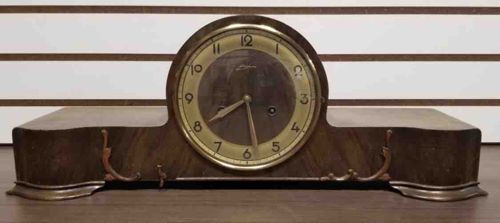
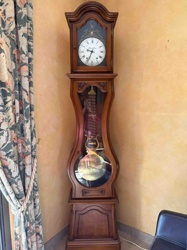
Junghans Art Deco mantel clock. Winds and chimes every 30 minutes
These notes were written by the person who submitted this item. Appraiser.AI has not verified them, and the AI's identification and estimate may rely on them.
AI Estimated Value
Not an official valuation
$250 - $400
AI estimate as of June 27, 2025 · verify with a professional before acting
AI-Generated · Verify before acting
Everything on this page is generated by AI for informational purposes only. AI can make mistakes — the AI may misidentify items or misattribute them (artist, maker, brand, designer, origin, era). This is not an official valuation and should not be used for insurance, sale, tax, estate, legal, or lending purposes — or any decision requiring a certified appraisal. It is not an authoritative claim about any person, brand, or rights holder — do not share or rely on it as a factual statement about a third party. Always consult qualified professionals before making financial decisions.
This analysis also relies on unverified notes provided by the user, which may be incomplete or inaccurate and could affect the result.
The item is a Junghans Art Deco mantel clock, exemplifying the distinctive streamlined aesthetic of the early to mid-20th century, specifically dating from the 1920s to 1940s. Its robust physical characteristics include a substantial horizontal wooden case, likely crafted from a rich, dark burled or figured wood veneer such as walnut, showcasing attractive, swirling grain patterns. The main body of the case features a stepped or gently curved rectangular base, providing a solid foundation. Integrated seamlessly into the center of this base is a prominent semi-circular housing that artfully frames the clock face.
At the heart of the design, the clock face is encircled by a polished gilded or brass-toned metal bezel. The dial itself has a subtly contrasting finish, possibly brushed brass or a darker metallic tone, against which clear, black Arabic numerals for all 12 hours are displayed. The minute and hour hands are dark-toned, simple, and elegant, perfectly complementing the overall clean design. Below the central axis of the hands, a small keyhole or adjustment point is visible, likely for time setting or pendulum regulation. The reputable "Junghans" manufacturer's name is subtly inscribed on the dial, indicating its German origin.
Distinguishing features include decorative, sweeping metal (likely brass or bronze) scrollwork elements positioned symmetrically along the base on either side, adding a refined touch of ornamentation that balances the geometric form. The visible condition suggests a natural patina and some minor surface wear consistent with age, though no significant damage or structural issues are apparent, indicating a well-preserved piece. The metal components also show expected patination. The clock is noted to be in working order, winding and chiming every 30 minutes, which speaks to the enduring quality and craftsmanship of its mechanical movement, a significant attribute for a vintage timepiece.
AI Appraisal Report
Upon examining the provided images and description of this Junghans Art Deco mantel clock, I find it to be a handsome and well-preserved example from the 1920s-1940s period. The figured wood veneer case, likely walnut, and the symmetrical brass or bronze scrollwork are highly characteristic of the Art Deco style, and the piece appears authentic to its era. Its condition is very good for its age, with expected minor surface wear and a pleasing patina on the metal elements, which does not detract from its overall appeal. The 'Junghans' mark on the dial is consistent with known examples from the period. The most significant factor boosting its value is its reported working condition, including the half-hour chiming mechanism. This indicates a well-maintained an an 8-day mechanical movement. The market for quality Art Deco timepieces remains steady, particularly for reputable German makers like Junghans. While examples are not exceptionally rare, complete and functioning pieces in this condition are always in demand by collectors and decorators. The aesthetic balance of geometric forms and elegant ornamentation makes this a particularly desirable model. A definitive authentication would require an in-person examination to inspect the movement for maker's marks and serial numbers, and to assess the originality of all components, including the finish and metalwork. However, based on the visual evidence, it presents as a genuine period piece.