AI estimate as of August 14, 2025 · verify with a professional before acting
AI-Generated · Verify before acting
Everything on this page is generated by AI for informational purposes only. AI can make mistakes — the AI may misidentify items or misattribute them (artist, maker, brand, designer, origin, era). This is not an official valuation and should not be used for insurance, sale, tax, estate, legal, or lending purposes — or any decision requiring a certified appraisal. It is not an authoritative claim about any person, brand, or rights holder — do not share or rely on it as a factual statement about a third party. Always consult qualified professionals before making financial decisions.
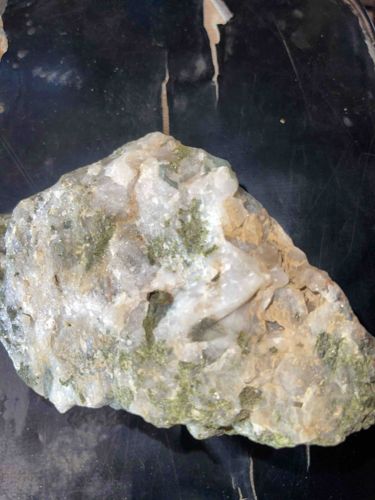
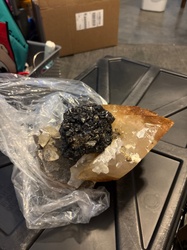
This item is a rough, unpolished mineral specimen, likely a variety of Quartz due to its translucent to opaque white and colorless crystalline structures. The rock is irregularly shaped, exhibiting a jagged, natural fracture. A dominant feature is the presence of significant green inclusions and surface coatings, which appear to be moss, lichen, or a type of mineral growth such as chlorite, giving it a mottled green and white/beige appearance. The size is difficult to ascertain precisely without a scale, but it appears to be a hand-sized piece. The material exhibits both larger, crystalline formations, some appearing somewhat translucent, and finer, granular textures. There are no obvious signs of human modification, such as cutting or polishing, indicating its natural state. The surface shows some rough edges and natural divots, common in raw mineral finds. No apparent maker's marks, signatures, or stamps are discernible, consistent with a naturally occurring mineral. The specimen's condition appears stable, with no visible breaks or repairs, though the green growth suggests it was found in an environment conducive to such biological or mineral accumulation. The overall impression is that of a geological sample, possibly collected for its aesthetic appeal or for study due to the interesting juxtaposition of the crystalline quartz and the green inclusions. The quality is indicative of a natural formation rather than a crafted object.
AI Appraisal Report
Based on my visual examination of the provided image, this specimen is a rough, unpolished piece of Quartz with significant green inclusions, likely moss, lichen, or chlorite. Its authenticity as a natural mineral specimen appears high; the irregular shape, jagged fractures, and lack of human alteration strongly support its natural origin. The condition is excellent for a raw specimen, showing no signs of damage, repair, or undue degradation. The green growth is a natural accumulation and expected for such finds.
Market conditions for natural, unpolished mineral specimens like this are generally niche. Value is primarily driven by aesthetic appeal, size (which is difficult to assess precisely from the image), and the vibrancy/uniqueness of inclusions. While quartz itself is not rare, specimens with distinct and aesthetically pleasing green inclusions (often called 'Garden Quartz' or 'Lodolite' if mineral inclusions) can command higher prices. This piece, with its substantial green coverage, has good visual interest. Its primary appeal is as a decorative display piece or a collector's item for those interested in natural geological formations.
Factors impacting value include the precise identification of the green growth (moss vs. chlorite), which is hard to determine from an image. If the green is mineral (chlorite), it often holds more value in the mineral collecting community than biological growth. The lack of polished facets limits its appeal to jewelry makers, keeping its value in the raw specimen category. Without a scale, estimating size accurately is a significant limitation.
Limitations in authenticity verification from images alone are notable. While the natural state is evident, confirming the exact mineral composition of the green inclusions (moss, lichen, or specific mineral like chlorite) would require in-person microscopic examination, scratch tests, or potentially X-ray diffraction. Provenance documentation regarding its origin (mine, geological survey, specific find location) would add significant collector value and help authenticate its natural state beyond doubt, but this is rare for uncelebrated natural finds.