AI Appraisal Estimate

AI-generated estimates · not official valuations

From the user

What was submitted

Photo and notes provided by the user — not generated by AI

Submitted item photo
Submitted photo · June 12, 2026

User's notes

No additional notes provided.

AI analysis below

AI appraisal

AI analysis & estimate

AI-Generated · Verify before acting

Everything below is generated by AI for informational purposes only. AI can make mistakes — the AI may misidentify items or misattribute them (artist, maker, brand, designer, origin, era). This is not an official valuation and should not be used for insurance, sale, tax, estate, legal, or lending purposes — or any decision requiring a certified appraisal. It is not an authoritative claim about any person, brand, or rights holder — do not share or rely on it as a factual statement about a third party. Always consult qualified professionals before making financial decisions.

Read the full disclaimer

AI Identification

·Not independently authenticated·Verify before acting

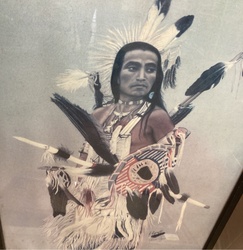
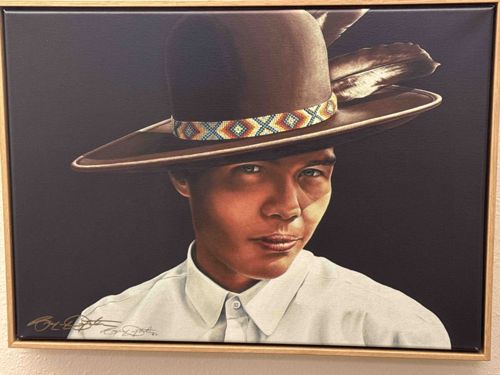
Framed Canvas Portrait Print of a Native American Man by Earl Biss

Fine Art - Contemporary Indigenous Art Prints

AI Estimated Value

·Not an official valuation·Verify before acting

$450–$750

As of June 12, 2026

AI Item Analysis

·AI can make mistakes·Verify before acting
This item is a contemporary giclée or high-quality canvas print of a portrait by the renowned Apsáalooke (Crow) artist Earl Biss (1947–1998). The artwork depicts a focused portrait of a young Native American man wearing a high-crowned brown hat adorned with a multi-colored beaded band in traditional geometric patterns and a large feather tucked into the brim. He is dressed in a crisp, white button-down shirt against a dark, monochromatic background that emphasizes the subject's features. The print displays a dual signature in the lower-left corner: one large stylized signature in gold-tone ink and a smaller, secondary signature next to it in white or silver. The piece appears to be a modern canvas wrap, likely a reproduction of an original oil painting, and is housed in a simple, light-toned wood 'floater' style frame. The craftsmanship of the reproduction shows fine detail in the skin tones and texture of the canvas. The condition appears excellent with no visible fading, tears, or surface abrasions, though the frame has a minimal gap characteristic of floater designs. Biss was a member of the 'Big Five' of the Institute of American Indian Arts, and his style typically blends dynamic expressionism with traditional subjects, making this a significant piece for collectors of contemporary Indigenous art.
AI Appraisal Report

·AI can make mistakes·Verify before acting
I have conducted a visual examination of the framed canvas print attributed to Earl Biss. The piece presents as a high-quality giclée or mechanical reproduction on canvas rather than an original oil painting. This is evidenced by the uniform surface texture and the presence of dual digital signatures—a common feature in modern estate-authorized or licensed editions. The condition appears to be excellent, with well-preserved pigment saturation and a modern floater frame that suggests contemporary production. Earl Biss was a pivotal figure in the 'New American Indian Art' movement. While his original oil works can command $10,000 to $50,000+, high-end canvas reproductions maintain a steady secondary market value due to the artist's enduring popularity and the accessibility of his expressionist style. Comparables for similar licensed canvas wraps of this size typically hammer in the $300 to $600 range at regional auctions, with retail gallery prices slightly higher. Limitations: This appraisal is based strictly on photographic evidence. I cannot definitively verify the printing method (e.g., whether it is a hand-embellished giclée or a standard flat-bed print) which would influence value. A physical inspection is required to check for UV damage, confirm the substrate material, and examine the verso for edition numbers or stamps from the Biss estate. Furthermore, full authentication would require provenance documentation or a certificate of authenticity from a recognized publisher or the artist's estate. In the absence of an edition number (e.g., 5/100), this is treated as an open-edition decorative piece of high-quality craftsmanship.

Get your items appraised

Instant estimates of your treasures with AI-powered appraisals

Browse More Appraisals