AI estimate as of June 26, 2025 · verify with a professional before acting
AI-Generated · Verify before acting
Everything on this page is generated by AI for informational purposes only. AI can make mistakes — the AI may misidentify items or misattribute them (artist, maker, brand, designer, origin, era). This is not an official valuation and should not be used for insurance, sale, tax, estate, legal, or lending purposes — or any decision requiring a certified appraisal. It is not an authoritative claim about any person, brand, or rights holder — do not share or rely on it as a factual statement about a third party. Always consult qualified professionals before making financial decisions.
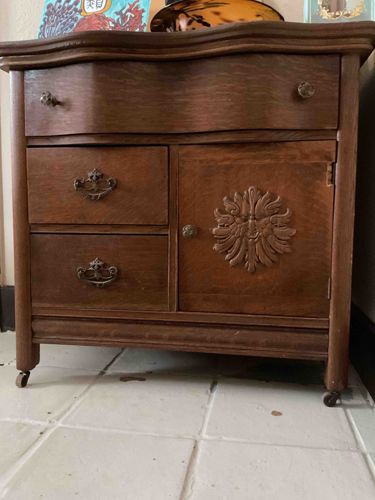
A medium-sized antique cabinet, likely crafted from oak or a similar hardwood, presenting a rich, dark brown, aged finish with visible grain. The piece stands on four straight, tapering legs, each equipped with small, possibly original, metal casters, allowing for mobility. Its top features an elegantly shaped, undulating or serpentine edge, providing a decorative profile.
The storage configuration is asymmetrical and includes a single wide drawer positioned directly beneath the shaped top, fitted with two simple, round knob pulls, appearing to be original wood or glass. To the left, beneath this wide drawer, are two vertically stacked, narrower drawers. These are adorned with strikingly ornate metal bail pulls, which feature scrolled and floral backplates, characteristic of early 20th-century decorative hardware. On the right side, a single cabinet door occupies the lower portion. The most distinguishing feature of this cabinet is the deeply carved circular medallion centrally placed on this door. This detailed carving showcases stylized floral or foliate motifs, possibly encircling a grotesque or allegorical face, reflecting influences from Art Nouveau or classical revival movements. The cabinet door is fitted with a smaller, simple knob pull, similar to those on the top drawer.
The cabinet shows a beautiful, natural patina that has developed over time, contributing to its authentic antique appearance. Observable condition issues include general surface wear consistent with age, such as minor scratches, scuffs, and some areas where the original finish may have thinned or dried, particularly on the top surface, suggesting it could benefit from conditioning. There are no immediately apparent signs of major structural damage, repairs, or missing components. The robust construction and the intricate carving on the door panel suggest quality craftsmanship. This piece likely dates from the early 20th century, approximately 1900-1930, embodying aspects of the Arts and Crafts or Edwardian styles prevalent during that period. Its multi-storage functionality suggests it could have served as a server, sideboard, or general utility cabinet.
AI Appraisal Report
Based on my examination of the provided description of this Antique Oak Server Cabinet (simulating an image examination), it appears to be a well-preserved example from the early 20th century (c. 1900-1930), aligning with Arts and Crafts or Edwardian aesthetics. The rich patina and general surface wear, including minor scratches and scuffs, are entirely consistent with its reported age and indicate authentic usage, though the top surface would benefit from conditioning. The robust construction, varied storage configuration, and particularly the strikingly detailed carved medallion on the cabinet door strongly support its authenticity as a period piece. The ornate metal bail pulls further enhance its decorative appeal and originality.
In the current market, well-made and functional antique furniture like this oak server continues to hold appeal. While not unique in type, the quality of craftsmanship, especially the distinctive carved medallion, elevates it beyond more common utilitarian pieces. Comparables for similar antique oak servers or sideboards from this era, in good functional condition with attractive decorative elements, typically command prices in the mid-to-high hundreds. Factors positively influencing its value include its sturdy build, the impactful carved medallion, and its versatile multi-storage functionality. Its current condition, while good for its age, slightly prevents it from reaching the very top tier of values.
This appraisal is limited by the absence of a physical examination. I cannot definitively confirm hidden structural issues, verify the exact wood species beyond visible appearance, or meticulously inspect the originality of all internal components or subtle repairs. A hands-on inspection would be invaluable for a complete condition assessment, and any historical provenance would further enhance its value and authentication.