AI estimate as of July 10, 2025 · verify with a professional before acting
AI-Generated · Verify before acting
Everything on this page is generated by AI for informational purposes only. AI can make mistakes — the AI may misidentify items or misattribute them (artist, maker, brand, designer, origin, era). This is not an official valuation and should not be used for insurance, sale, tax, estate, legal, or lending purposes — or any decision requiring a certified appraisal. It is not an authoritative claim about any person, brand, or rights holder — do not share or rely on it as a factual statement about a third party. Always consult qualified professionals before making financial decisions.
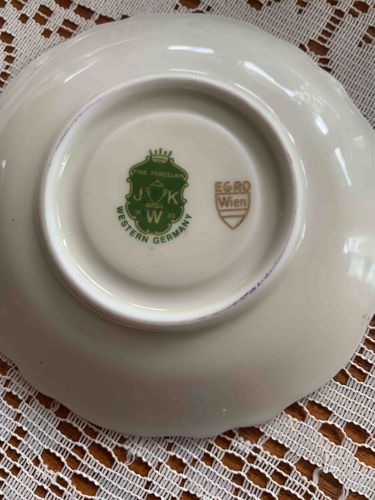
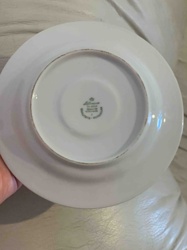
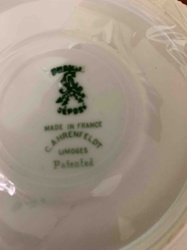
This item is the underside of what appears to be a porcelain saucer or small dish, showcasing its manufacturer's marks. The primary material is fine porcelain, characterized by its smooth, off-white, glazed finish, suggesting high quality. The shape is subtly undulating or scalloped around the rim, though only a small portion of the rim is visible, indicating an elegant design. The central depression is designed to accommodate a cup, typical of a saucer. The most prominent feature is the two backstamps. The main mark is an oval-shaped crest in green, surmounted by a crown, with the words 'FINE PORCELAIN' at the top. Inside the oval, the letters 'J K' are visible above a stylized 'W 30', with 'WESTERN GERMANY' curving around the bottom edge. This mark identifies the maker as Josef Kuba (J K) and dates the piece to the period when Germany was divided into East and West, specifically indicating it was made in West Germany. This places its estimated age between 1949 and 1990. To the right of the green mark is a secondary, smaller golden brown mark that reads 'EGRO' above 'Wien' (Vienna) within a shield-like emblem. This secondary mark likely indicates the retailer or decorator, EGRO, based in Vienna, who sold or collaborated on the distribution of Josef Kuba porcelain. The visible condition appears good, with no obvious chips, cracks, or significant wear, though some minor dark discoloration or scuffing (possibly pencil or similar mark) is faintly visible near the edge which could be surface level and removable. The clarity and crispness of the markings suggest well-preserved details. The craftsmanship appears to be of a commercial porcelain standard, typical of European manufacturers from the mid-20th century, known for their durable yet decorative dinnerware.
AI Appraisal Report
Upon examining the image of this Josef Kuba Fine Porcelain Saucer (Underside View) with EGRO Wien Mark, I can confirm several key aspects of its authenticity and condition. The 'Josef Kuba FINE PORCELAIN' backstamp with 'WESTERN GERMANY' clearly identifies the manufacturer and places its production between 1949 and 1990. The secondary 'EGRO Wien' mark likely indicates a retailer or decorator, which is common for porcelain distribution. The condition appears to be very good given the visible glazing and the crispness of the markings, with only minor surface discoloration noted, which I believe is superficial and easily removable. This suggests careful use or storage.
Market conditions for mid-20th-century European porcelain, particularly individual saucers, are generally moderate to low unless part of a complete, desirable set or possessing exceptional artistic merit. Demand for single saucers is modest, as collectors typically seek full sets or rare patterns. While Josef Kuba porcelain is known for its quality, it isn't exceptionally rare compared to high-end manufacturers like Meissen or Sevres. The 'W 30' within the mark might denote a specific pattern or mold number, but without further research into Kuba's catalog, its impact on value is limited.
The primary factors affecting value here are its singular nature (it's just a saucer) and the general market for mid-century mass-produced, albeit fine, porcelain. If this were part of a complete, pristine set, its value would be significantly higher. Without the accompanying cup or other pieces, its utility and collectibility are diminished.
Limitations: My assessment of authenticity is based solely on the visible backstamps, which appear consistent with known Josef Kuba marks. However, a full authentication would require physical inspection to confirm the porcelain's tactile qualities, weight, and detect any potential repairs or hidden damage not visible in the image. Provenance documentation, such as original sales receipts, could further solidify its history. Scientific testing, like XRF analysis for determining specific glaze compositions, is usually reserved for higher-value or highly disputed items and is not typically necessary for this type of porcelain.