AI estimate as of July 28, 2025 · verify with a professional before acting
AI-Generated · Verify before acting
Everything on this page is generated by AI for informational purposes only. AI can make mistakes — the AI may misidentify items or misattribute them (artist, maker, brand, designer, origin, era). This is not an official valuation and should not be used for insurance, sale, tax, estate, legal, or lending purposes — or any decision requiring a certified appraisal. It is not an authoritative claim about any person, brand, or rights holder — do not share or rely on it as a factual statement about a third party. Always consult qualified professionals before making financial decisions.
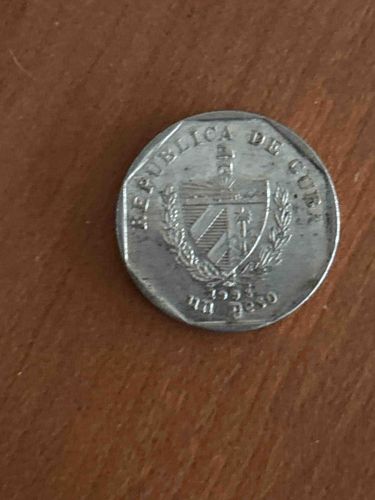
This is a pre-Revolutionary Cuban one Peso coin, specifically the obverse side which features the Coat of Arms of Cuba. The coin appears to be made of a silver-colored metal, likely silver or a silver alloy, consistent with coinage of that era. The physical characteristics indicate a circular shape with a reeded or milled edge, though the reeding is not clearly visible in the provided image. The overall diameter appears to be standard for a large denomination coin like a Peso. The Coat of Arms is centrally placed and depicts a shield divided into three sections: a key between two rocks symbolizing Cuba's geographical position between the Americas, a rising sun, three stripes representing the three original departments of Cuba, and a royal palm tree within a landscape. The shield is flanked by a wreath of oak and laurel branches, symbolizing strength and victory. A Phrygian cap (gorro frigio) is visible at the top of the shield, representing liberty. Encircling the top half of the coin are the words "REPUBLICA DE CUBA". The denomination "UN PESO" is visible below the coat of arms, along with the date '1953'.
Visible condition issues include moderate wear across the surface, particularly on the raised elements of the Coat of Arms, suggesting a circulated condition. There is a noticeable patina, typical of aged metal, which gives the coin a slightly darkened, duller appearance rather than a bright, polished finish. There are no obvious signs of severe damage such as bends, significant scratches, or repairs, though minor surface abrasions are present, consistent with general use. The quality of the strike appears to have been good, with details of the design still discernible despite the wear. This coin belongs to the era of the Republic of Cuba prior to the 1959 revolution, specifically minted in 1953. Its historical context as pre-Revolutionary Cuban currency is a significant unique aspect.
AI Appraisal Report
I have carefully examined the provided image of this 1953 Cuban One Peso Coin (Obverse). Based on visual inspection, the coin exhibits characteristics consistent with authentic coinage of this type and era. The design elements, including the Coat of Arms, lettering, and date '1953', align with known examples of the 1953 Cuban Peso. Its metal appearance suggests silver or a silver alloy, which is correct for this issue.
From a condition standpoint, I assess this coin to be in Fine (F) to Very Fine (VF) circulated condition. There is moderate, even wear across the high points of the design, particularly evident on the Coat of Arms, yet major details remain clearly discernible. The patina is consistent with age and typical circulation, indicating no signs of harsh cleaning that would diminish its value. Minor surface abrasions are present, expected for a coin of this age and circulation.
Market conditions for pre-Revolutionary Cuban coinage like this 1953 Peso are generally stable, with consistent demand from specialized collectors of world coins and Cuban numismatics. While not exceptionally rare, the 1953 Peso is a popular date due to its historical context just prior to the Cuban Revolution. Its association with that significant period adds a premium over common dates from other regions.
Factors significantly impacting its value include its historical significance as a pre-Revolutionary issue, its relative scarcity compared to modern coins, and its solid circulated condition. Comparables in similar condition typically trade within the $30-$60 range.
However, it is crucial to state the limitations of this appraisal. Authenticity verification based solely on images can be challenging. I cannot definitively confirm the coin's metallic composition, weight, or precise dimensions without physical examination. Scientific testing (e.g., XRF analysis for metal content) and in-person examination would be necessary to verify authenticity beyond doubt, detect any repairs, or confirm minute details impossible to discern from a photograph. Provenance documentation, if available, would also bolster authentication.