AI estimate as of November 29, 2025 · verify with a professional before acting
AI-Generated · Verify before acting
Everything on this page is generated by AI for informational purposes only. AI can make mistakes — the AI may misidentify items or misattribute them (artist, maker, brand, designer, origin, era). This is not an official valuation and should not be used for insurance, sale, tax, estate, legal, or lending purposes — or any decision requiring a certified appraisal. It is not an authoritative claim about any person, brand, or rights holder — do not share or rely on it as a factual statement about a third party. Always consult qualified professionals before making financial decisions.
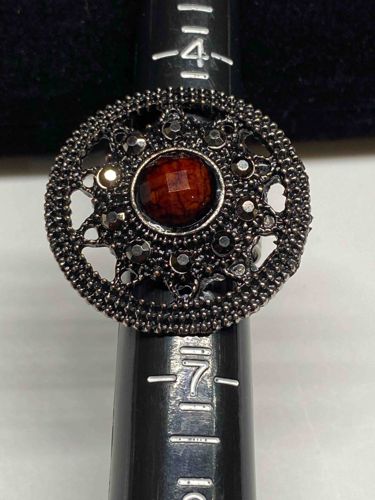
This is a large, ornate statement ring featuring a circular, filigree-style design with pave-set dark gemstones and a central faceted reddish-brown gemstone. The ring appears to be made of a dark-toned metal, possibly oxidized silver, gunmetal, or a base metal alloy with a dark plating, giving it an antique or gothic aesthetic. The overall circumference of the ring's face suggests it would cover a significant portion of the finger. The central stone is round, cabochon-like in its overall profile but with noticeable facets across its surface, creating a subtle play of light; its color is a rich, warm reddish-brown, possibly a garnet-colored glass, resin, or a semi-precious stone like carnelian or tiger's eye, though without better magnification, it's hard to tell for sure. Surrounding this central stone is an intricate openwork design, often referred to as filigree, which is densely encrusted with numerous small, dark, pave-set gemstones – likely glass, marcasite, or dark cubic zirconia – that catch the light with subtle sparkle. The craftsmanship indicates a decorative, fashion-forward piece, possibly mass-produced, given the uniform setting of the smaller stones. The ring is displayed on a ring sizer, indicating a size between 7 and 8, likely a 7.5. There are no visible major damages such as missing stones or significant wear to the metalwork, suggesting it is in good to very good condition. The dark patina across the metal enhances the contrast with the stones and contributes to its vintage-inspired or bohemian appeal. The piece exemplifies a style that bridges art deco influences with modern costume jewelry trends.
AI Appraisal Report
Based on my visual examination of the provided image, this Filigree Pave Statement Ring presents in good to very good condition. There are no obvious signs of missing stones or significant wear to the dark-toned metal, which appears to be a base metal with a dark plating, possibly gunmetal or oxidized silver, contributing to its antique/gothic aesthetic. The central reddish-brown gemstone, while faceted, has the overall profile of a cabochon; its material is likely glass, resin, carnelian, or tiger's eye. Without direct inspection, I cannot confirm its exact composition or if it's a semi-precious stone. The surrounding pave-set dark gemstones are likely glass, marcasite, or dark cubic zirconia, adding a subtle sparkle. The intricate filigree design suggests a decorative, fashion-forward piece, likely mass-produced given the uniformity of the settings. This style is popular in costume jewelry, blending art deco and bohemian influences.
Market conditions for comparable mass-produced costume jewelry of this design and material quality typically place retail values in the $35-$75 range. Demand often comes from buyers seeking fashionable accessories rather than intrinsic material value. Rarity is low due to likely mass production. Factors impacting value significantly include the materials used; if the central stone were definitively a specific semi-precious gem like garnet or carnelian, and the pave stones were genuine marcasite, it would lean towards the higher end of the range.
Limitations in authenticity verification are significant from images alone. A physical examination would be crucial to confirm metal composition (e.g., sterling silver vs. base metal), accurately identify the central gemstone and pave stones, and assess the quality of craftsmanship up close. Spectroscopic analysis or gemological testing would be needed for definitive stone identification. Provenance documentation could also add to its historical or collectible value, though unlikely for this type of piece.