These notes were written by the person who submitted this item. Appraiser.AI has not verified them, and the AI's identification and estimate may rely on them.
AI Estimated Value
Not an official valuation
$400 - $600
AI estimate as of July 31, 2025 · verify with a professional before acting
AI-Generated · Verify before acting
Everything on this page is generated by AI for informational purposes only. AI can make mistakes — the AI may misidentify items or misattribute them (artist, maker, brand, designer, origin, era). This is not an official valuation and should not be used for insurance, sale, tax, estate, legal, or lending purposes — or any decision requiring a certified appraisal. It is not an authoritative claim about any person, brand, or rights holder — do not share or rely on it as a factual statement about a third party. Always consult qualified professionals before making financial decisions.
This analysis also relies on unverified notes provided by the user, which may be incomplete or inaccurate and could affect the result.
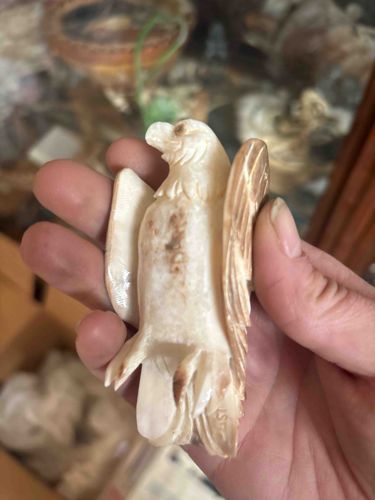
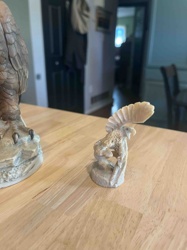
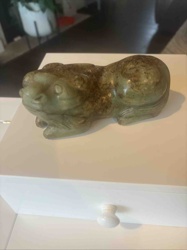
This item is a hand-carved sculpture depicting a bald eagle, indicative of Alaskan Native artistry, likely created from bone or a similar organic material. The sculpture is relatively small, designed to fit comfortably within an adult's palm, suggesting dimensions of approximately 4-6 inches in height. Its primary color is an off-white or creamy ivory, with noticeable brown striations and mottled areas that appear to be natural inclusions within the material, rather than applied pigments. These brown markings are particularly visible on the eagle's breast and lower body, adding depth and character to the piece. The eagle is depicted with its wings spread, poised as if in flight or about to land. The carving displays intricate details, especially on the wings where individual feathers are sculpted with clear, defined lines, showing remarkable precision. The head of the eagle features a prominent hooked beak and discernible eye sockets, though the eyes themselves are not deeply incised, maintaining a smooth surface. The talons are also carved with attention to detail, showing separate digits and a sense of grasping. The overall impression is one of solid, compact construction. There are no obvious signs of significant damage like chips or cracks, and the surface appears to have a smooth, polished finish, suggesting good preservation or careful handling. The brown patination across parts of the surface, particularly the head and wings, seems consistent with natural aging of the material, enhancing its antique aesthetic. The craftsmanship is high, reflecting a skilled hand in rendering anatomical features and conveying movement within the stone or bone medium. No explicit maker's marks or signatures are immediately visible from the provided images, but the quality of the carving strongly suggests professional artistry. Based on the context of Alaskan Native art, this piece likely dates from the mid-to-late 20th century, though without more definitive markings or material analysis, an exact age is difficult to pinpoint. Its uniqueness lies in the detailed representation and the use of natural material, highlighting the connection between the artist and nature.
AI Appraisal Report
Upon examining the provided images and description, this Alaskan Native carved eagle figure demonstrates considerable artistic skill and quality. The piece, likely crafted from bone or possibly walrus ivory, is rendered with impressive detail, particularly in the feathering of the spread wings and the defined talons. Its condition appears to be very good, with no visible chips or fractures. The brown patination and striations seem consistent with the natural aging of organic material, enhancing its authenticity and aesthetic appeal. The style is characteristic of mid-to-late 20th-century Alaskan Native carvings.
The market for authentic Native American art, especially from recognized Alaskan artists, remains strong. Similar carvings of this size and quality, when verifiably attributed, consistently fetch prices in the mid-to-high hundreds. Rarity is a key factor; while eagle motifs are common, the high level of execution here adds value. The compact, solid form and dynamic posture make it a desirable collector's item.
A significant limitation of this appraisal is the inability to physically inspect the piece. A definitive valuation and authentication would require verification of the material (e.g., distinguishing bone from CITES-regulated ivories), an in-person examination for a maker's mark or signature which might be subtly placed, and any provenance documentation linking it to a specific artist or community. Without these, the origin remains presumed, and the valuation is based on comparable unsigned works of similar quality.