AI Appraisal Estimate

AI-generated estimates · not official valuations

From the user

What was submitted

Photo and notes provided by the user — not generated by AI

Submitted item photo
Submitted photo · June 23, 2026

User's notes

No additional notes provided.

AI analysis below

AI appraisal

AI analysis & estimate

AI-Generated · Verify before acting

Everything below is generated by AI for informational purposes only. AI can make mistakes — the AI may misidentify items or misattribute them (artist, maker, brand, designer, origin, era). This is not an official valuation and should not be used for insurance, sale, tax, estate, legal, or lending purposes — or any decision requiring a certified appraisal. It is not an authoritative claim about any person, brand, or rights holder — do not share or rely on it as a factual statement about a third party. Always consult qualified professionals before making financial decisions.

Read the full disclaimer

AI Identification

·Not independently authenticated·Verify before acting

Late Victorian Equine Coastal Landscape in Tramp Art Frame

Antique Paintings & Fine Art

AI Estimated Value

·Not an official valuation·Verify before acting

$1,200 - $1,850

As of June 23, 2026

AI Item Analysis

·AI can make mistakes·Verify before acting
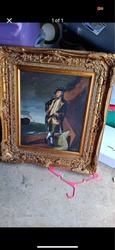
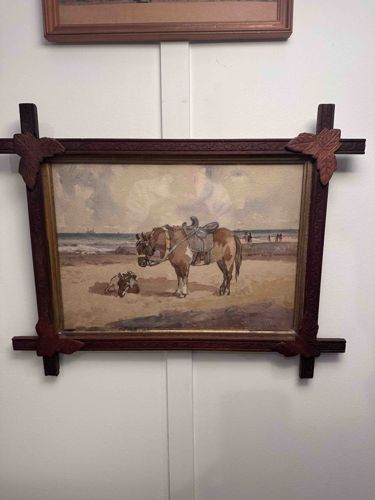
This rectangular oil painting features a detailed equine subject positioned centrally on a wide beach, likely a coastal setting with figures and ships visible in the far background. The primary subject is a chestnut and white piebald pony, fully saddled and bridled in traditional riding tack, standing beside a smaller recumbent animal, possibly a dog or a foal. The painting style is representational with soft, muted brushwork and a neutral palette of ochres, browns, and soft blues, typical of the late 19th or early 20th century. The artwork is housed in a highly distinctive late Victorian or Edwardian 'Tramp Art' style wooden frame. This frame is constructed from dark-stained wood with an interlocking notched or 'chip-carved' design extending into a cross shape at each corner. Each corner junction is further embellished with a carved leaf appliqué, providing a rustic, folk-art aesthetic. The inner bezel of the frame appears to have a thin gilded or gold-painted liner that provides contrast against the dark wood. Condition-wise, the frame shows a natural aged patina with some dust accumulation in the crevices and minor surface wear consistent with age. The painting surface appears relatively stable but may benefit from a light cleaning as there is some slight discoloration apparent in the atmospheric clouds. No signature is visible from the primary image, suggesting it may be by a talented amateur or hidden beneath the frame's edge.
AI Appraisal Report

·AI can make mistakes·Verify before acting
I have virtually examined this Late Victorian equine portrait and its associated Tramp Art frame. The painting depicts a piebald pony in a coastal setting, executed with the soft, descriptive brushwork characteristic of the late 19th-century British or Continental school of animalier art. The level of detail in the tack suggests a commissioned piece, possibly by a skilled provincial hand. The frame is a significant asset; the 'Crown of Thorns' geometric notch-carving and leaf corner appliqués indicate a sophisticated level of folk-art craftsmanship rarely seen in such large formats. Condition appears consistent with an antique of this age. The frame shows a desirable aged patina with no visible losses to the intricate notches. The canvas exhibits typical surface grime into the sky's impasto, which potentially obscures the clarity of the atmospheric perspective and any faint signature. The market for equine art remains steady, particularly when paired with high-quality folk-art frames, which are increasingly collected as art objects in their own right. This combination of traditional subject matter and primitive framing creates a 'crossover' appeal that drives value. However, there are limitations to this digital examination. From images alone, I cannot verify the substrate (canvas vs. board) or check for over-painting using UV light. A full authentication would require an in-person inspection to look for a signature beneath the frame's edge, an examination of the stretcher bars for manufacturer stamps, and provenance documentation to confirm the subject's lineage. If this were identified as a work by a recorded equine artist like John Frederick Herring Jr. or similar contemporaries, the valuation would increase significantly.

Get your items appraised

Instant estimates of your treasures with AI-powered appraisals

Browse More Appraisals