AI estimate as of December 5, 2025 · verify with a professional before acting
AI-Generated · Verify before acting
Everything on this page is generated by AI for informational purposes only. AI can make mistakes — the AI may misidentify items or misattribute them (artist, maker, brand, designer, origin, era). This is not an official valuation and should not be used for insurance, sale, tax, estate, legal, or lending purposes — or any decision requiring a certified appraisal. It is not an authoritative claim about any person, brand, or rights holder — do not share or rely on it as a factual statement about a third party. Always consult qualified professionals before making financial decisions.
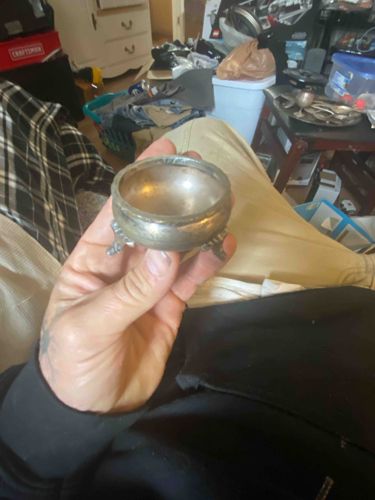
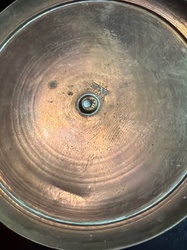
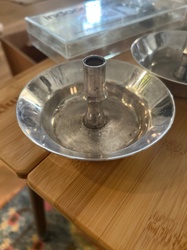
This appears to be a small, circular, footed bowl, likely made of a silver-toned metal, possibly silver plate or pewter, given its somewhat tarnished and dull appearance. Its dimensions are quite small, fitting comfortably in the palm of a hand, suggesting it might be a salt cellar, a trinket dish, or part of a miniature tea set. The bowl has a simple, unadorned rim, and its main body is smooth, showing some signs of wear and surface scratching consistent with age and use. A notable feature is the presence of three small, ornate feet that elevate the bowl. While the exact details of the feet are difficult to discern due to the image quality, they appear to have a decorative, possibly scrolled or claw-like design, adding an element of elegance to the piece. The metal exhibits a dark, dull patina, particularly in the crevices and on the feet, indicating that it has not been recently polished and has likely accumulated tarnish over time. There are no visible maker's marks or signatures in the provided images. Given its style, it could range from late 19th to mid-20th century, often consistent with Victorian or Edwardian revival pieces, or even earlier if it is a truly antique piece with heavy tarnish. The craftsmanship seems moderately detailed, especially in the feet, suggesting it was produced with some attention to aesthetic appeal. The interior of the bowl also shows a similar aged, somewhat dull metallic finish.
AI Appraisal Report
Upon examining the image of this miniature footed bowl, I observe an item likely crafted from a silver-toned metal, possibly pewter or silver plate, judging by its overall dullness and significant tarnish. Its small size strongly suggests it was intended as a salt cellar, a trinket dish, or perhaps part of a dollhouse miniature set. The condition is consistent with age and use, displaying surface scratching and a heavy, dark patina, particularly within the ornate feet. The feet, though obscured by tarnish, appear to have a scrolled or claw-like design, indicating a moderate level of decorative intent. Authenticity, based solely on this image, points to an item from the late 19th to mid-20th century. Without physical inspection, I cannot definitively determine the metal composition (e.g., sterling silver, silver plate, pewter, or pot metal), which is a significant factor in value. The absence of visible maker's marks further limits specific attribution.
Market conditions for such small, unidentifiable metalware pieces are generally modest. Comparable items, typically found in antique malls or online marketplaces, retail in the sub-$50 range unless they possess verifiable sterling silver content, a renowned maker's mark, or exceptional provenance. Demand for miniature footed bowls without a clear function or prestigious origin is low, and they are not particularly rare. The primary factors impacting value here are the unknown metal composition and the lack of identifying marks. If it were confirmed sterling silver, the value would increase based on weight and design. For a full authentication and more precise valuation, a physical examination would be crucial to test the metal content, search for micro-stamps under magnification, and assess the craftsmanship more thoroughly. Provenance documentation would also be highly beneficial.