These notes were written by the person who submitted this item. Appraiser.AI has not verified them, and the AI's identification and estimate may rely on them.
AI Estimated Value
Not an official valuation
$1,800 - $3,500
AI estimate as of July 22, 2025 · verify with a professional before acting
AI-Generated · Verify before acting
Everything on this page is generated by AI for informational purposes only. AI can make mistakes — the AI may misidentify items or misattribute them (artist, maker, brand, designer, origin, era). This is not an official valuation and should not be used for insurance, sale, tax, estate, legal, or lending purposes — or any decision requiring a certified appraisal. It is not an authoritative claim about any person, brand, or rights holder — do not share or rely on it as a factual statement about a third party. Always consult qualified professionals before making financial decisions.
This analysis also relies on unverified notes provided by the user, which may be incomplete or inaccurate and could affect the result.
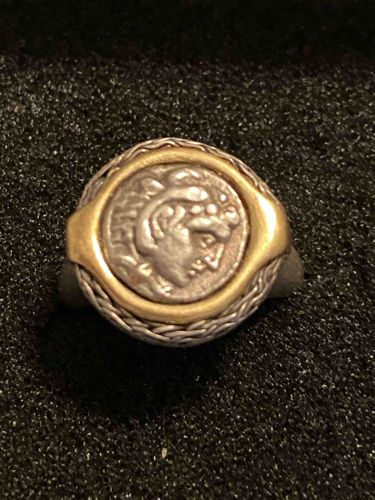
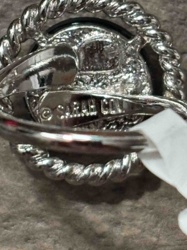
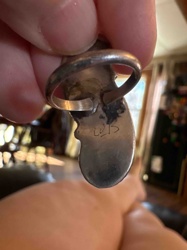
This item is a ring featuring a central round, silver-colored coin or medallion set within a prominent gold-tone bezel and surrounded by an intricate silver-colored band. The central element of the ring is a round disc, likely a coin or a medallion designed to appear as such, depicting a laureate head in profile. The head faces to the right (from the viewer's perspective) and exhibits classical features, including a strong nose and chin, and hair that appears to be styled with prominent curls or perhaps a lion's scalp headdress, characteristic of depictions of figures like Alexander the Great or Hercules. The silver-colored material of the central disc shows signs of wear and age, with a visible patina and some surface scratching consistent with an older item or one designed to mimic antiquity. The gold-tone bezel encircling this central disc is polished and smooth, creating a striking contrast with the more aged look of the silver element. The ring's band, particularly the shoulders leading up to the main setting, is crafted from a silver-colored metal and features an ornate, woven, or braided design. This intricate metalwork wraps around the side of the gold bezel, adding to the decorative appeal. The overall construction suggests a robust build, designed to showcase the central coin-like element. The visible condition indicates general wear, including minor abrasions on the metals, and the coin's relief showing some flattening due to handling and age. The presence of '750' and '950' stamps, as provided in the context, suggests the gold elements are 18K gold (750 parts per thousand) and the silver elements are platinum (950 parts per thousand) or a very high-grade silver alloy, indicating high material quality. The style period is evocative of historical or classical Greek/Roman jewelry, likely a reproduction or 'coin jewelry' piece from the 20th or 21st century designed to evoke that era, rather than an authentic ancient artifact given the setting's characteristics. The craftsmanship, particularly the detailed braid work and the secure bezel setting, points to a well-made, quality piece of jewelry.
AI Appraisal Report
Based on my examination of the provided image and information regarding this Alexander the Great inspired coin ring, I can offer the following professional appraisal. This piece is undeniably striking, featuring a central silver-colored 'coin' with a laureate head, likely representing Alexander the Great or Hercules, set within a prominent gold-tone bezel and an intricately braided silver-colored band. The '750' and '950' stamps are critical; '750' indicates 18K gold for the bezel, and '950' indicates platinum for the silver-colored elements, or a very high-grade silver alloy. Assuming platinum for the '950' stamp, this significantly increases material value. The condition appears consistent with general wear, showing minor abrasions and patina, which aligns with an item of its proposed age or design intent. While the 'coin' mimics an ancient artifact, the overall design and craftsmanship, especially the secure bezel and detailed braid, suggest a well-made contemporary piece, likely from the 20th or 21st century, designed to evoke classical antiquity rather than an actual ancient artifact.
Market demand for classical-inspired jewelry, especially pieces with substantial precious metal content, is consistently strong. Comparable pieces, leveraging similar high-karat gold and platinum or high-grade silver with detailed craftsmanship, command respectable prices. Rarity is moderate; while not a one-of-a-kind antique, the specific combination of design, quality of materials, and craftsmanship makes it a desirable item. The primary factors impacting value are the precious metal content (especially if the '950' is indeed platinum, which would mean a higher value), the quality of craftsmanship, and the aesthetic appeal of the classical motif. The 'coin' itself is not an ancient artifact but a decorative element, and its value is derived from its design and material.
My assessment of authenticity is limited to what can be observed visually. The stamps appear consistent with known hallmarks. For full authentication and accurate metal assessment, a physical examination by a certified gemologist or appraiser is required. This would involve testing the metal composition to confirm 18K gold and definitively identify the '950' metal (platinum or high-grade silver alloy). Verification of the 'coin' as a modern high-quality reproduction rather than an ancient artifact would also be confirmed by direct inspection. Provenance documentation, if available, would further enhance certainty and value.